NotePlan: Best all-in-one planner for note-takers. Free for 7 days on Setapp.
Todoist: Best for team collaboration and task management
Any.do: Best for mobile users who need reminders
Pagico: Best for visual project management. Free for 7 days on Setapp.
ClickUp: Best for complex team projects and customization
TaskPaper: Best for minimalist, text-based planning. Free for 7 days on Setapp.
Calendars: Best for calendar-driven planning. Free for 7 days on Setapp.
Best value: Many of the best planners are available on Setapp. Try NotePlan, Pagico, TaskPaper, Calendars, and 300+ other apps free for 7 days with a Setapp Membership.
In this article, I'll review the best daily planner apps I've chosen from dozens of tools and help you find the perfect digital planner for your needs. The list includes simple planners with to-do lists and more complex apps with tasks, goals, whiteboards, events, and calendars.
Natural language event creation and elegant multi-calendar view
* Setapp is a subscription platform that gives you access to 300+ apps for macOS, iOS, and web.
A complete guide to the best daily planner apps
Here's a detailed look at the daily planner apps that can help organize your tasks, projects, and life.
NotePlan (Mac) – Best for markdown notes & planning
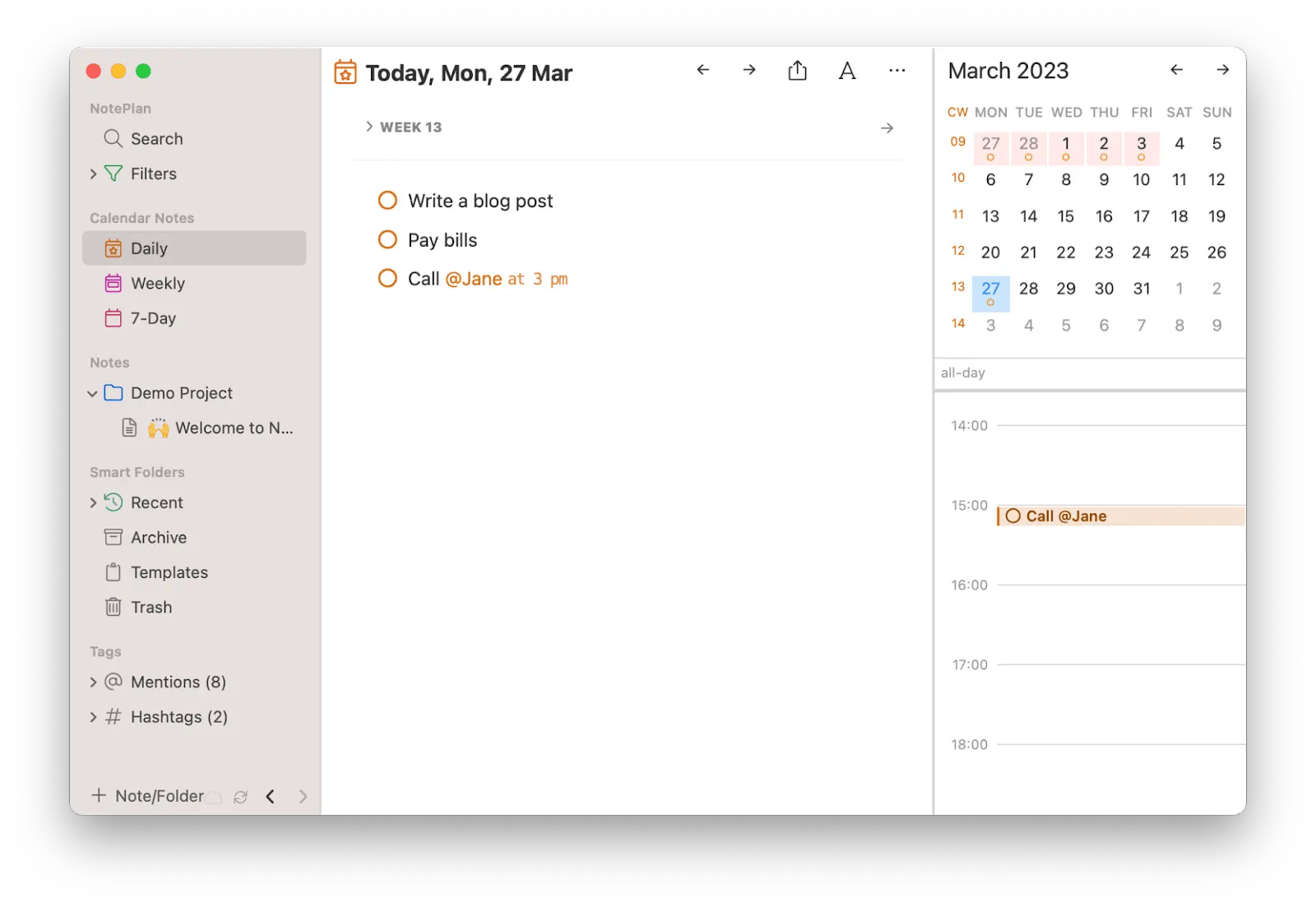
The fastest way to combine tasks, notes, and calendar in one Mac app is NotePlan from Setapp (free for 7 days). It's a powerhouse for anyone whose plans start as notes.
NotePlan is best for
Solo planners, freelancers, and anyone who wants to connect daily tasks directly to their notes and calendar events. If you practice bullet journaling or use systems like Zettelkasten, it might be the best choice for you.
Problems NotePlan solves
Scattered information: NotePlan combines notes (that can be combined into separate folders), calendars, and to-do lists, so you don't need to jump between different apps.
Lack of control. Everything in the app can be organized into folders, or with hashtags, or mentions, and then — filtered by tons of categories, so nothing ever gets lost. The views and layouts are fully customizable, making it perfect for anyone who loves organization and complete control.
Manual task rollover: The app has an overdue filter that shows all overdue tasks and lets you drag and drop them wherever you need — to a note, calendar, or any other destination.
Lack of context: Basically, everything in NotePlan can be linked together, so you can build a personal wiki of your work — connecting related tasks, ideas, to-dos, and more.
NotePlan feature benefits
Data storage: Local Markdown files on your Mac by default, with optional iCloud sync across Apple devices. Your notes stay readable in any text editor.
Creates a separate note for each day, which syncs with your calendar events.
Supports bi-directional links.
Offers community plugins like CRM (to manage contacts, log interactions, schedule follow-ups, and more), Expenses (to track your finances), Journaling Helpers, Math Solver, Habit Tracker, and more.
NotePlan strengths
Strong visual organization: calendar-dated notes and project notes are clearly distinct. You can easily tell daily tasks apart from long-term plans.
Integrates tightly with Apple Calendar and Reminders.
Includes handy templates for time blocking, daily notes, monthly OKRs, annual reviews, and more.
Each note can be customized with patterns, colors, styles, icons, priorities, and statuses — settings you can apply to individual notes or copy across others.
Apple integration: Native macOS and iOS apps with iCloud sync, plus deep two-way integration with Apple Calendar and Reminders.
NotePlan limitations
Limited team collaboration. NotePlan offers Spaces for shared workspaces where teams or families can collaborate on notes, folders, and calendar entries, but full real-time collaboration is still limited.
Using NotePlan in your workflow
Imagine you have a meeting about "Project Phoenix." In your daily note, you type Meeting with @Jane about [[Project Phoenix]]. During the meeting, you add tasks like * Draft proposal >2026-07-25 right under the meeting line. The task is now scheduled, the project note is linked, and your collaborator is tagged. Later, when you open your "Project Phoenix" note, you see a backlink to today's meeting notes, keeping everything connected automatically. This is perfect for consultants, researchers, and anyone who needs to document their work as they do it.
Since NotePlan is part of Setapp, you can pair it for free with Focused Work to run Pomodoro timers alongside your daily notes — start a 25-minute session for the top task in your day view and stay on it.
I use Noteplan all day. The app has greatly improved over the years. The fact that it keeps all data in local markdown files is very important for future proofing. 99% of other similar apps store in proprietary storage. I tried obsidian but Noteplan is more simple which is a good thing. Obsidian is cool but there are just too many features to get lost in and the UI is king of cringe. This app is a really nice balance. NotePlan user from Reddit
Pricing info on NotePlan
NotePlan is available on Setapp with a 7-day free trial along with 250+ apps for Mac, iPhone, and iPad. Install as many apps as you want for the price of a single subscription.
Todoist (Mac) – Best for cross-platform task management
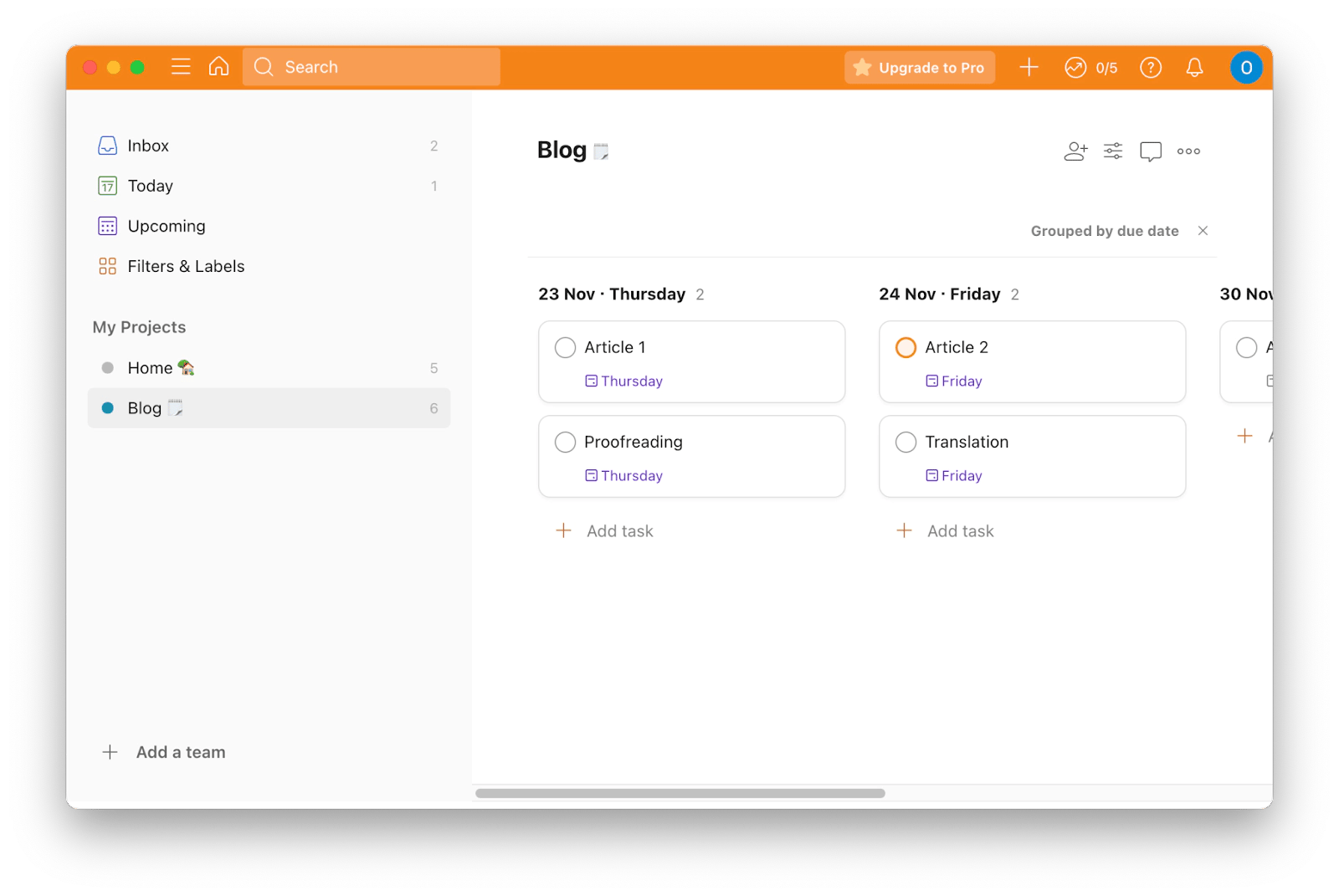
Todoist is one of the most popular and reliable task managers available. It strikes a great balance between advanced features and a clean, simple interface, making it a fantastic starting point for building a daily planning habit.
Todoist is best for
Individuals and teams who follow the Getting Things Done (GTD) methodology, and like Kanban boards.
Problems Todoist solves
Mental clutter: Todoist's quick-add feature with natural language processing (e.g., "Team meeting every Tuesday at 10am #Work") lets you get tasks out of your head and into an organized system instantly.
Inconsistent planning: Features like recurring due dates and reminders help build a consistent daily planning routine.
Project chaos: You can organize tasks into projects, add sub-tasks, and even view them on Kanban-style boards to manage workflows from start to finish.
Todoist feature benefits
Data storage: Cloud-based on Todoist's servers. Syncs automatically across all devices; no local-only or offline-first mode.
Recognizes natural language for dates, priorities, and projects when you add tasks.
Offers customizable filters and labels to create personalized daily views (e.g., "all priority 1 tasks due today").
Integrates with dozens of apps, including Evernote, Slack, Microsoft Teams, Zapier, Chrome, Firefox, and many more.
Todoist strengths
Available on Mac, iOS, Android, Linux, and Windows.
The interface is clean, intuitive, and beginner-friendly.
Gamifies productivity by awarding points for completing tasks.
TodoPlan limitations
Real planning sits behind a paid plan. The free tier caps you at 5 personal projects, 3 filter views, and 1 week of activity history — calendar layout, deadlines, custom reminders, and project templates all require Pro at $60/year for this one app. A Setapp membership bundles NotePlan, Pagico, TaskPaper, Calendars, and 270+ other apps under a single subscription instead.
It's a task manager rather than a full-fledged planner, so most users end up pairing it with a separate calendar tool — another subscription on top.
Using Todoist in your workflow
A common and effective workflow is to use Todoist as your task inbox and a calendar app (like Google Calendar or Calendars on Setapp) for execution. Start your day by reviewing your Todoist "Today" view. Then, drag and drop your top 3-5 tasks from Todoist into open slots on your calendar. This time blocking method ensures you not only know what to do but also when you'll do it.
Since TaskPaper is part of Setapp, pair it for free with Focused Work to layer Pomodoro sessions over your text-based lists. Pick a task, start a 25-minute focus session, and keep TaskPaper open as your visible plan.
Pricing info on Todoist
Todoist offers a free plan with basic features. The Pro plan starts at $5 per user per month (billed annually).
Any.do (Mac) – Best for mobile-first reminders
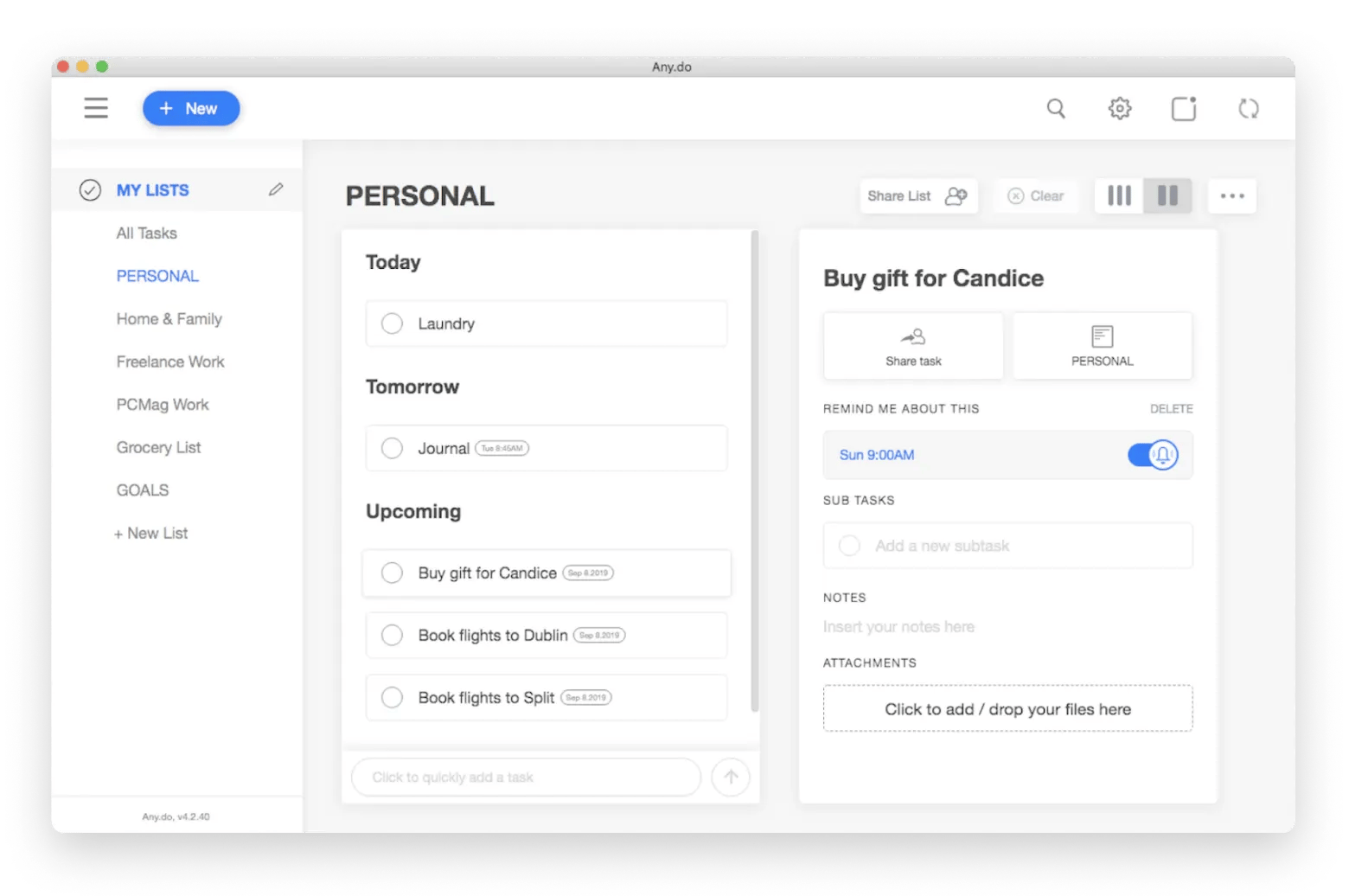
Any.do is a daily planner designed for people who live on their phones and need a simple way to organize tasks and, more importantly, be reminded of them. Its standout feature is its focus on getting you to plan your day, every day.
Any.do is best for
Mobile users, families, and anyone who struggles with forgetfulness. It excels at reminding you of tasks through its "Plan my Day" feature and location-based alerts. With all these features, it can even be customized for habit tracking.
Problems Any.do solves
Daily procrastination: Your day can start with the app's notification, "Good morning, friend!" and a prompt to build your plans. It pushes you to review your tasks and decide which ones to tackle today, reschedule, or delete.
Forgetting tasks: Smart reminders are really persistent and can notify you via WhatsApp, based on your location, on a smart watch, and more.
Family disorganization: Family plan users can share grocery lists, chore plans, and events together — up to full family vacation planning.
Any.do feature benefits
Data storage: Cloud sync via Any.do's servers. All data lives online for cross-device access.
Encourages you to plan your day every day. Forgot to plan? It can remind you.
Syncs with your calendar.
Has handy widgets.
Offers location-based reminders on mobile devices.
Any.do strengths
Lets you create tasks by sending a message to the Any.do bot in WhatsApp.
An AI assistant can help you with task creation, smart suggestions, prioritization, and daily planning.
Offers plans for individuals, families, and teams.
Any.do limitations
Basics are paywalled. Color tags, custom themes, and location reminders require Premium at ~$60/year, and the Family plan (~$100/year for 4 members) has no free trial to test first. Setapp includes NotePlan, Pagico, TaskPaper, Calendars, and 270+ other apps under one subscription — no per-feature paywalls.
Not the best fit for complex projects with many checklists and to-dos.
Using Any.do in your workflow
Use Any.do as your personal assistant. Before you leave the house, add a location-based reminder to pick up dry cleaning on your way home. When your phone detects you're near the dry cleaner's, you'll get an alert. For daily planning, commit to using the "Plan my Day" feature every morning with your coffee. In just a few minutes, you'll have a clear list for the day ahead.
Pricing info on Any.do
Any.do has a free version. The Premium plan, which unlocks most features, is $4.99/month (billed annually). Family and Teams plans are $8.33/month (for 4 members) and $4.99/month/member.
Pagico (Mac) – Best for visual project management
The best way to turn tasks into visual project timelines on Mac is Pagico from Setapp (free for 7 days). It's a mix of a planner app and project management tool that turns smaller tasks into lists, and lists into actionable timelines.
Pagico is best for
Project managers, researchers, and students who manage large projects with many moving parts. It's ideal for those who need to see how tasks, files, and deadlines relate over time.
Problems TaskPaper solves
Interface overwhelm: There are no complex buttons or menus in TaskPaper — it's just a piece of paper where you can create projects, tasks, and tags with shortcuts.
Slow task organization: Formatting is simple. To create a project, just put a colon at the end of your sentence. To create a task, start your line with a hyphen + space. Tags are beautifully simple, too: e.g., @due(2026-07-25).
Data lock-in: The app uses plain text, so your files can be edited in virtually any text editor or on any device, and they are unlikely to expire.
TaskPaper feature benefits
Data storage: Local plain-text files on your Mac. Files open in any editor and sync through iCloud Drive, Dropbox, or Git if you want cross-device access.
Your lists are formatted automatically.
Supports import/export with the Reminders app.
Allows you to extend the app's functionality with scripts (extensive JavaScript API) and themes (LESS/CSS stylesheets).
FAQ:
What is the best minimal daily planner for Mac?
For a minimal daily planner on Mac, TaskPaper is the strongest pick. It's a plain-text app where projects, tasks, and tags are created with simple keyboard shortcuts. Files are stored as plain text, so they open in any editor and won't get locked into a proprietary format. TaskPaper is available on Setapp with a 7-day free trial.
Is there a daily planner for Mac that combines tasks and calendar?
Yes. NotePlan combines tasks, notes, and calendar events in one interface, and syncs directly with Apple Calendar and Reminders. Each day gets its own note where you can schedule tasks alongside events. If your day is calendar-driven, Calendars takes the opposite approach — it centers your schedule and lets you drop tasks into open time blocks. Both are available on Setapp.
What's the best daily planner app for Mac without a monthly subscription?
If you want to avoid per-app monthly fees, Setapp bundles NotePlan, Pagico, TaskPaper, Calendars, and 270+ other Mac and iOS apps under a single membership. You get every planner reviewed in this article — plus productivity, writing, and utility apps — for one flat price, instead of stacking separate $60/year subscriptions for Todoist, Any.do, and each app you try.
Which daily planner app for Mac works best offline?
TaskPaper and NotePlan both work fully offline. TaskPaper stores everything as local plain-text files, so it needs no connection at all. NotePlan keeps its data in local Markdown files by default, so you can add cloud sync if you want, but the app doesn't depend on it. Both are on Setapp with a 7-day free trial.
What daily planner app for Mac is best for ADHD or people who forget tasks?
For people who forget to plan or check their lists, Any.do is designed around persistent reminders. Its "Plan My Day" prompt, location-based alerts, and WhatsApp notifications actively push you to review tasks. If you'd rather build a system around visible daily notes and time blocking, NotePlan creates a fresh note each day and shows overdue tasks in one filtered view, so nothing slips silently. NotePlan is included in Setapp.
Are there any daily planner apps that integrate well with other productivity software?
Yes. For example, Pagico from Setapp integrates well with Google Calendar, Trello, Evernote, and other apps.
Are there any daily planner apps that offer collaborative features for team-based productivity?
The best planner apps with collaborative features are Pagico from Setapp and ClickUp.
Can daily planner apps for Mac sync across multiple devices, such as an iPhone or iPad?
Some daily planner apps, such as Pagico, NotePlan, etc., can sync across multiple devices.
How do daily planner apps handle privacy and data security?
Many daily planner apps take steps to ensure the privacy and security of their users' data. For example, the Pagico app encrypts your saved data with 256-bit AES and transmits it over an SSL/TLS channel. Their servers will only sync your shared items. Unshared items are deleted from the systems instantly.
Are there any lesser-known daily planners that are worth exploring?
Most of us are familiar with Trello and Todoist. However, there are multiple lesser-known planner apps worth trying. For example, if you're a fan of minimalist user interfaces, you may like TaskPaper from Setapp. Or, if you like to have everything in one place (notes, calendars, and tasks) without overwhelming yourself, try NotePlan from Setapp.
Powerful apps live on Setapp
Ditch defaults and discover new gems on one app platform.






 Best solution
 Best solution