macOS Screen Sharing — built-in tool for quick access between Macs on the same network.
FaceTime Remote Control (macOS Sequoia/iOS 18+) — for helping loved ones with their Mac/iPhone.
TeamViewer — for professional IT support and cross-platform access; feature-rich standard.
AnyDesk — for fast performance and lightweight access.
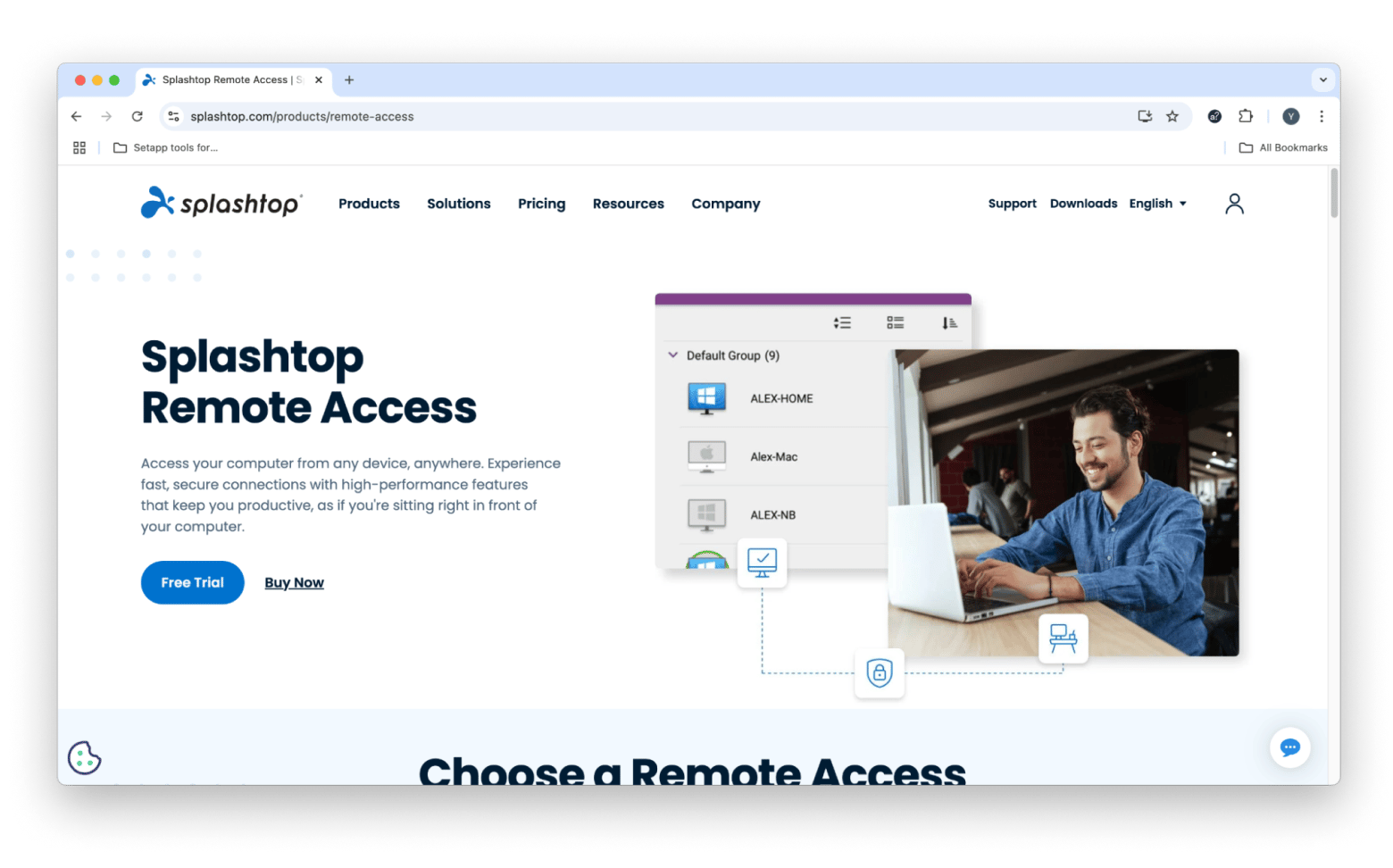
Splashtop — for creative work requiring color accuracy; high-fidelity video and audio streaming.
Remote access toolkit:
Remote Mouse from Setapp — turns iPhone/iPad into a remote control.
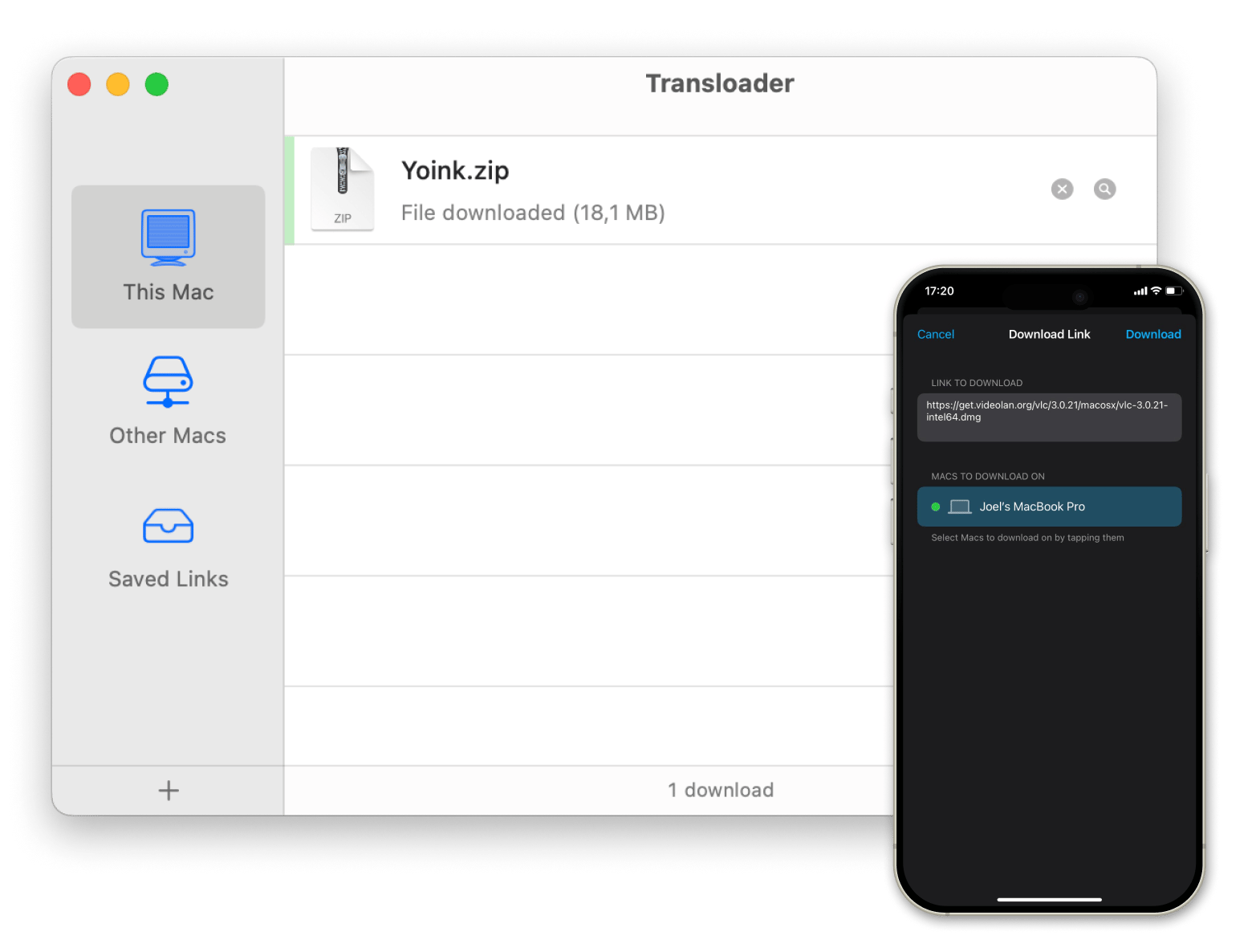
Transloader from Setapp — starts downloads on your Mac remotely.
Try both FREE for 7 days with Setapp Membership. Fully unlocked, no ads. Cancel before day 7 = $0.
In this article, I'll cover 5 remote desktop apps for Mac. Two are completely free, and one is free for personal use. Each covers a different use case and suits a different type of user. As a bonus, I'll show you how to turn your iPhone into a mouse and start remote downloads on your Mac.
The best RDP clients for Mac: Comparison
Let's start with a quick comparison, then dive into a detailed overview.
- File transfer - Multi-monitor support
- Session analytics
- File transfer
- Screen recording
- Built-in address book
- Multi-monitor support
- User role management
- 4:4:4 color accuracy - High-quality audio streaming
Best for
Mac-to-Mac local network access
Live, consent-based tech support for friends and family
IT admins, cross-platform power users
Fast, lightweight remote access, even on weaker internet
Creative professionals, small teams
User feedback
"Dead simple for family tech support"
"Lifesaver for guiding parents"
"Saved me fixing mom's Mac remotely"
"Unreal speed on slow Wi-Fi"
"Low latency for design work"
Built-in Mac remote access software
There are a few ways to remotely control a Mac using built-in remote desktop features. Let's take a closer look at what Apple has to offer.
A free built-in tool: Screen Sharing app on macOS
If Screen Sharing is enabled on your Mac, you can view and control it from any other Mac on the same local network. It's a perfect tool if you need to access files on a desktop Mac from your laptop or quickly adjust some settings on your dad's device in the next room.
Screen Sharing is best for
Mac users who need simple, secure remote control between two Macs on the same local network without installing third-party software.
Problems Screen Sharing solves
Local file access: Grab files from your desktop Mac while you're on the couch with your MacBook.
Family tech support: Troubleshoot your parent's Mac — you'll see their screen and control their mouse.
Headless server management: No need to connect another monitor if you need to manage a Mac mini or Mac Studio.
Screen Sharing feature benefits
Uses the VNC (Virtual Network Computing) protocol, a widely supported standard for remote control.
Lets you drag and drop files from one Mac to another.
Supports a shared clipboard: copy on one device, paste on another.
Screen Sharing strengths
It's free and is already on your Mac.
The connection is secure and encrypted.
The performance is excellent on a strong Wi-Fi network.
Screen Sharing limitations
It's officially designed for local network use only.
Lacks advanced features. For multi-user collaboration or cross-platform support, you'll have to turn to third-party apps.
Using Screen Sharing in your workflow
To get started, you first need to enable it on the Mac you want to control:
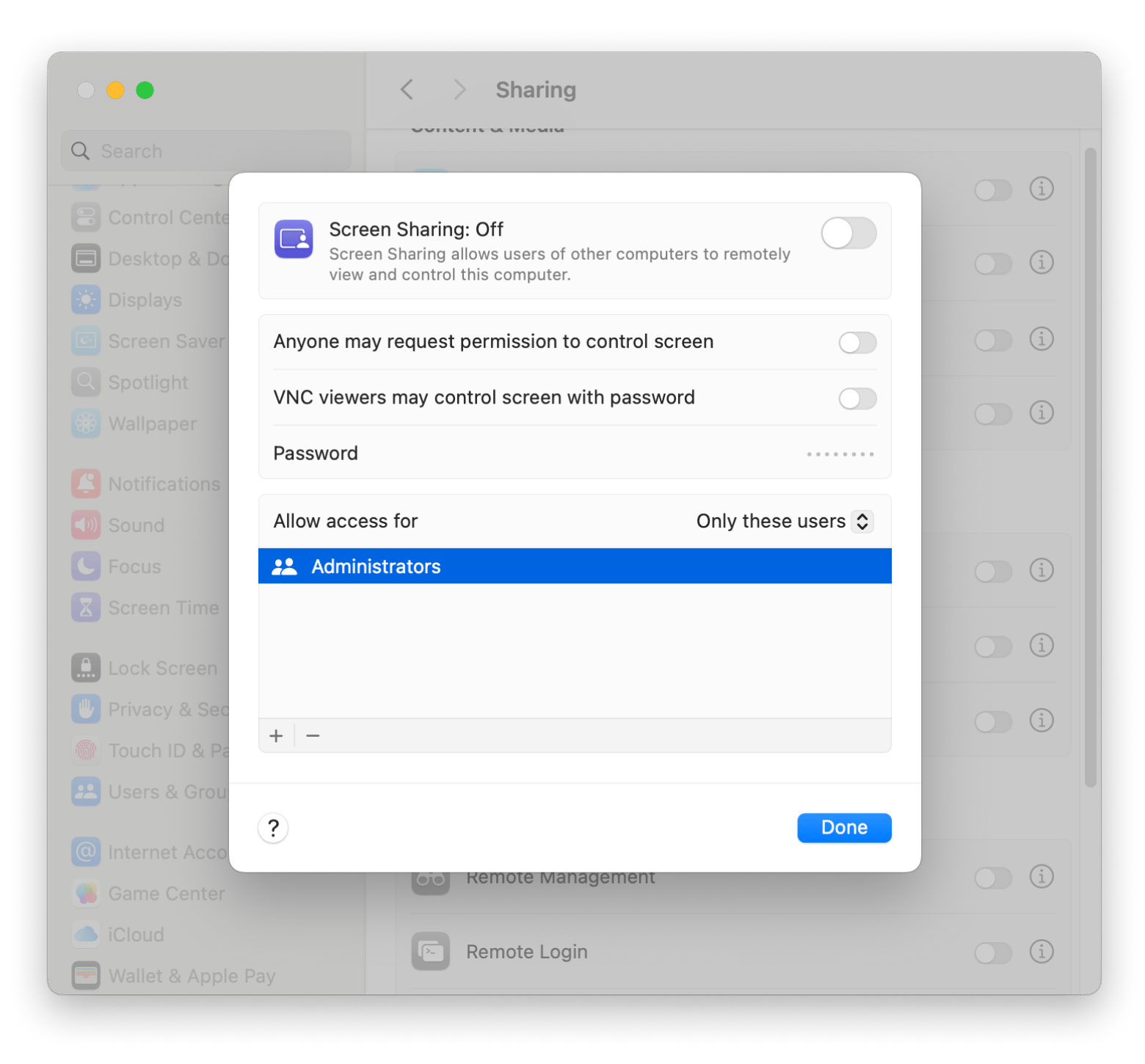
Go to System Settings > General > Sharing.
Toggle on Screen Sharing.
Click the (i) info button to configure access. In the "Allow access for" section, specify who can access your Mac.
Note your Mac's address (it starts with vnc://) to use on the other computer.
On the Mac you're controlling from:
Open the Screen Sharing app (via Spotlight) or in Finder, go to Go > Connect to Server.
Enter the address of the remote Mac (e.g., vnc://iMac.local) and click Connect.
Once connected, you can open apps, move files, and even restart the remote Mac.
Pricing info on Screen Sharing
Free and included with macOS.
Tip
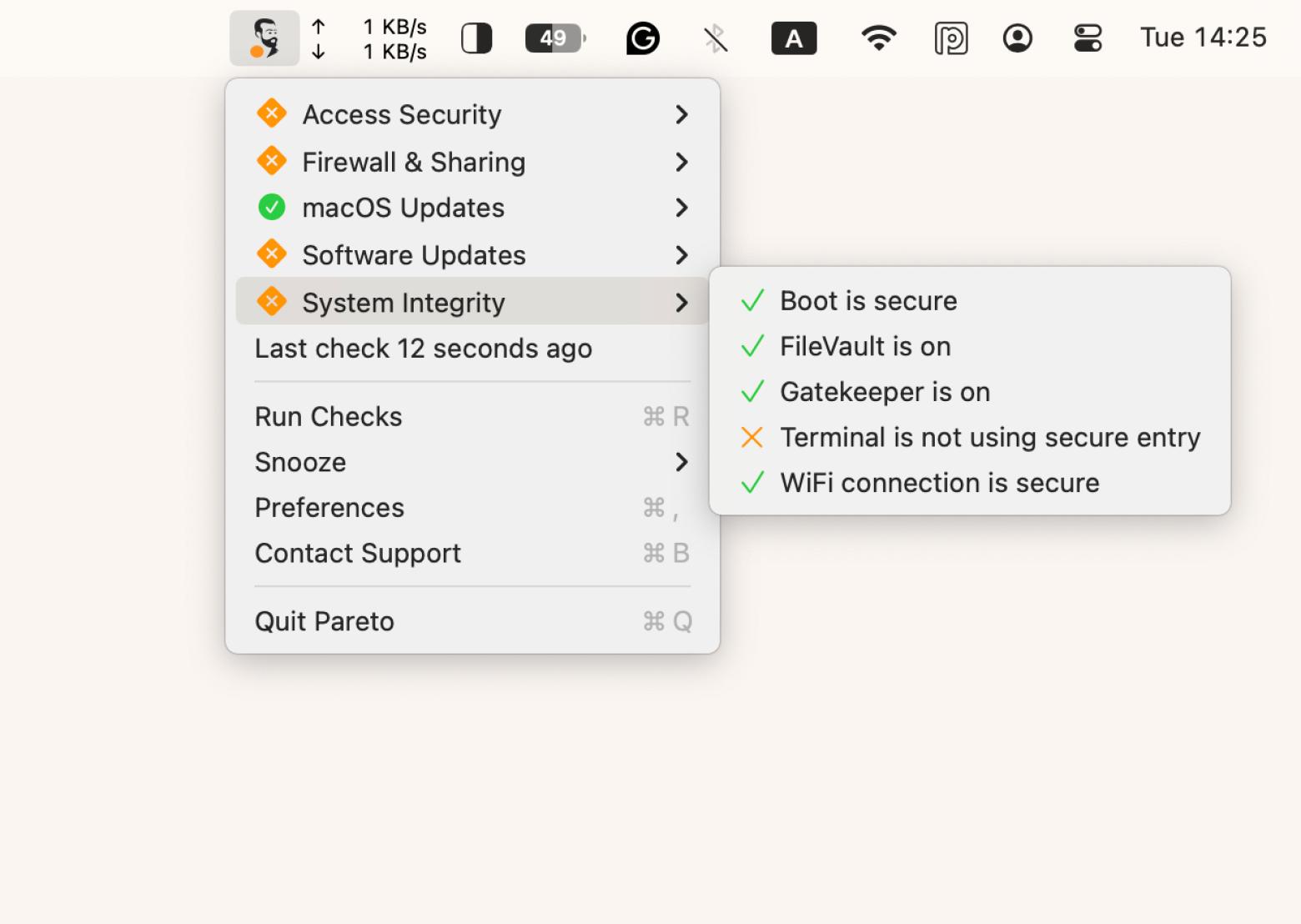
You might sometimes enable screen sharing on your Mac and then forget to turn it off. This could pose a security risk. Therefore, it's a smart idea to periodically perform security checks. I recommend using Pareto Security (it's available for free for 7 days with Setapp Membership) to run such security checks on your Mac, right from your menu bar. The app will identify all the settings you need to change to protect your computer.
Free Apple tool with limited access: Remote control in FaceTime
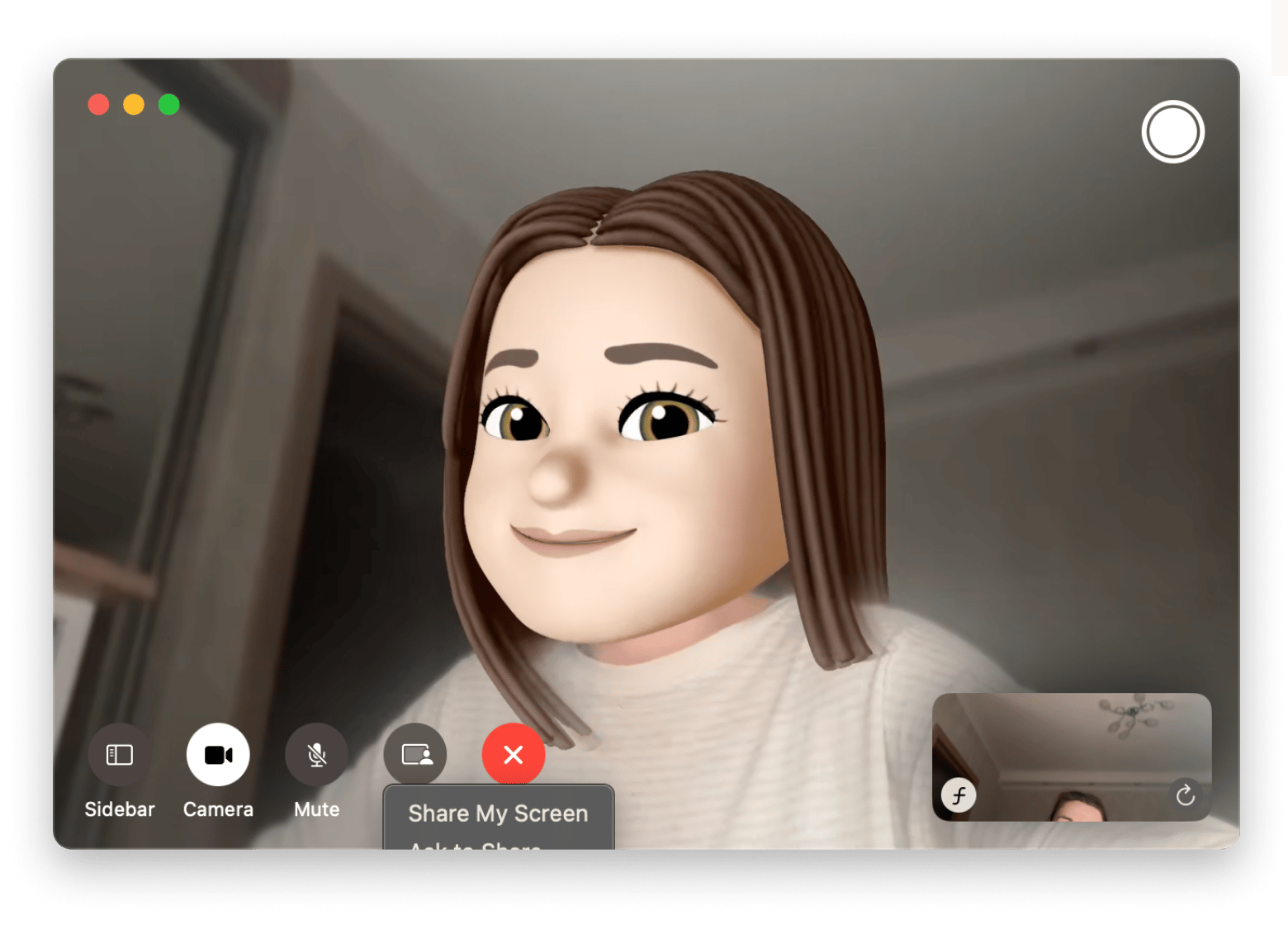
Starting with macOS Sequoia and iOS 18, you can grant or receive remote control of someone else's screen directly during a FaceTime call. This isn't a full remote desktop solution, but rather a powerful remote assistance tool perfect for helping someone in real time.
FaceTime Remote Control is best for
Quick, interactive tech support sessions with friends, family, or colleagues. Latest Apple software needed.
Problems FaceTime Remote Control solves
Visual troubleshooting: Guide a parent through changing an iPhone setting — you'll see their screen and point to buttons.
Collaborative tasks: You can take control over the app or document on your colleague's Mac to demonstrate a function or a workflow.
Impromptu support: A question just popped up in the middle of a conversation? You can give your support right away without asking the other person to install any software.
FaceTime Remote Control feature benefits
A presenter overlay mode lets you draw on the shared screen.
The person sharing their screen always has input priority, so they can stop the remote user's actions at any time.
Access lasts only during the screen-sharing session in the FaceTime call.
FaceTime Remote Control strengths
Natively integrated into FaceTime.
A remote user never gains access to sensitive data, such as passwords in Keychain, or to actions like making payments.
Works on Mac, iPhone, and iPad.
FaceTime Remote Control limitations
It requires both users to be on macOS Sequoia, iOS 18, or iPadOS 18 or later.
Control only works between devices of the same type (e.g., Mac-Mac).
The feature may not be available in all regions.
Using FaceTime Remote Control in your workflow
FaceTime remote control isn't ideal for long sessions — no one wants to spend hours on a call. But for quick fixes, it's hard to beat. If you need 5–15 minutes on a family member's or colleague's screen, give it a shot. Use it to walk through a workflow, tweak a setting, or guide someone around a new app.
Pricing info on FaceTime Remote Control
Free and included with macOS Sequoia, iOS 18, and iPadOS 18.
Third-party remote desktop clients for Mac
When built-in tools aren't enough, third-party apps offer more power, cross-platform support, and features for professional use.
For power users and customer service: TeamViewer
TeamViewer is one of the most well-known and feature-rich remote desktop clients. It's a common tool in the toolkits of IT admins and support professionals.
TeamViewer is best for
IT administrators, support professionals, and power users who need to manage computers across different operating systems (macOS, Windows, Linux).
Problems TeamViewer solves
Cross-platform support: Remotely control a Windows computer from your Mac or vice versa.
Unattended access: Set up permanent access to your own remote computers or servers so you can manage them anytime.
Complex support sessions: Manage multiple support sessions at once, transfer files, and more.
TeamViewer feature benefits
Allows file transfers, remote printing, and clipboard synchronization between connected devices.
Supports multi-monitor setups, letting you view and switch between all displays on the remote machine.
Provides session analytics and reporting for commercial users.
TeamViewer strengths
Cross-platform compatibility: macOS, Windows, Linux, iOS, and Android.
Strong 256-bit AES encryption and two-factor authentication.
The free version for personal use offers core features to help friends and family
TeamViewer limitations
The free version has aggressive commercial-use detection that can block connections if it suspects business activity. It's a common frustration for users accessing their own home servers.
The paid plans are more expensive than competitors'.
Using TeamViewer in your workflow
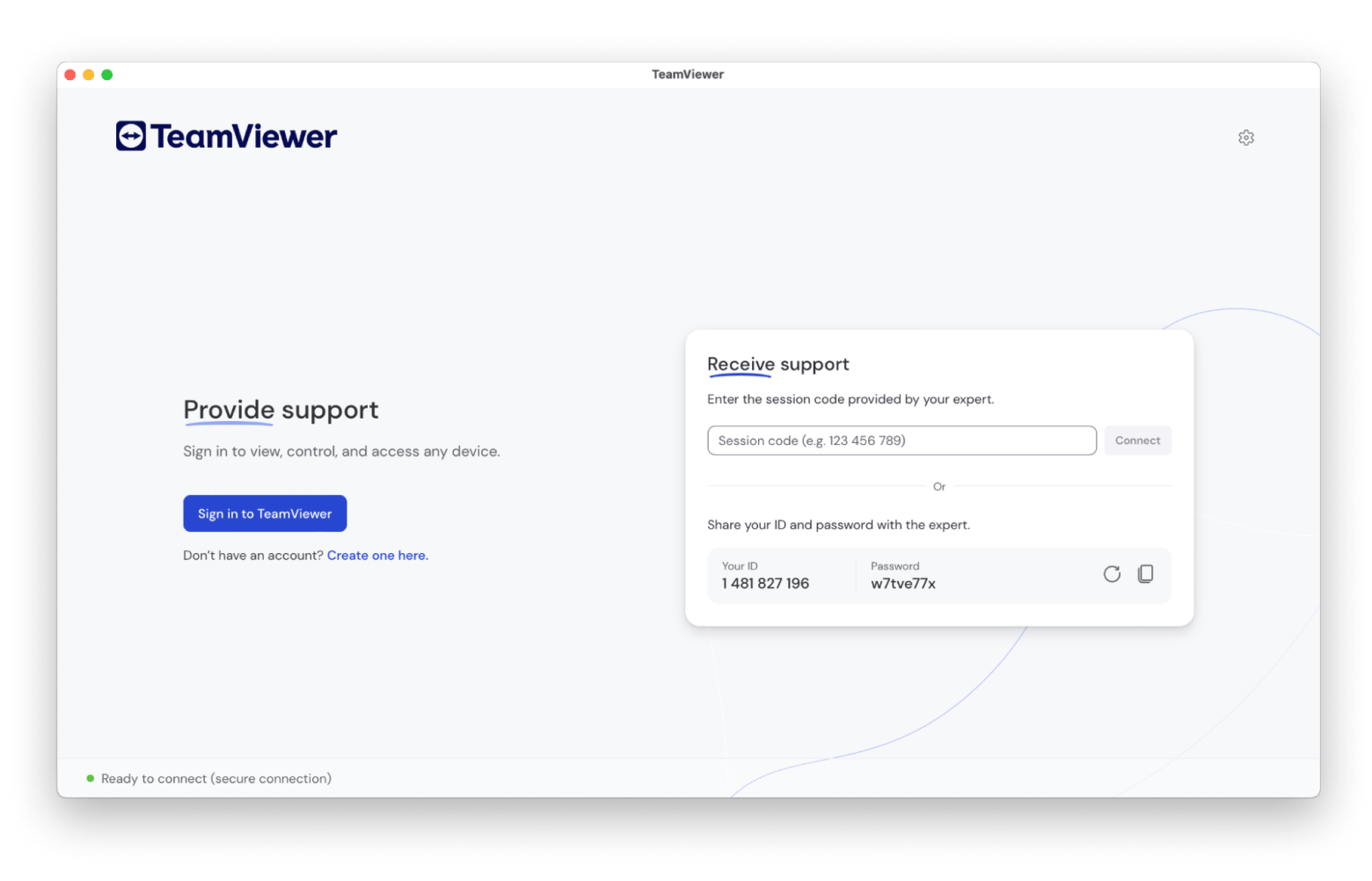
The setup isn't very difficult: install the TeamViewer app on both devices and set up an account to connect your machines. For a one-off support session, you can simply share the remote computer's ID and password. For ongoing access to your own devices, you can add them to your account for one-click connections. Who would I recommend TeamViewer to? Most likely, advanced users or anyone who needs to provide remote support as part of their job.
Pricing info on TeamViewer
Free for personal use. Paid plans start from $24.90/month for individual commercial users and from $120.90/month for teams.
A quick and free (for personal use) RDP client: AnyDesk
AnyDesk is famous for its speed and lightweight design. People love using it for remote work, especially when internet connections aren't perfect.
AnyDesk is best for
Remote workers, freelancers, and small teams who need fast, low-latency remote desktop connections.
Problems AnyDesk solves
Lag on slow networks: AnyDesk's DeskRT codec is designed for high performance. It gives a smoother experience on slower Wi-Fi or mobile connections where other tools might lag.
Quick ad hoc access: All you need to connect is a numeric ID.
Managing multiple clients: In a built-in address book, you'll see all your remote computers and their online status.
AnyDesk feature benefits
Supports unattended access with password protection for secure, anytime connections to your devices.
Has Wake-on-LAN feature that allows you to wake a remote device from sleep mode.
Allows you to record remote sessions.
AnyDesk strengths
Performance: users often find it feels more responsive than competitors.
The interface is clean and simple.
Platform support is huge: macOS, Windows, Linux, iOS, iPadOS, tvOS, Raspberry Pi OS, Android, Chrome OS.
Access for personal use — e.g., to help your family or friends with settings — is completely free.
AnyDesk limitations
The free version (personal use only) has become more restrictive, with session limits, reduced features, and commercial-use detection. If you were mistakenly blocked, you can submit a request on AnyDesk's website to be whitelisted.
Using AnyDesk in your workflow
Launch AnyDesk on both computers, share the personal ID from the remote machine, and enter it on your local machine to request a connection. Once the remote user accepts, you have full control. For your own devices, you can set a password for unattended access, which is perfect for working from home and connecting to your office Mac.
Pricing info on AnyDesk
Paid plans start at $28.90/month (billed annually) for the Solo plan.
Secure remote access: Splashtop
Splashtop has carved out a niche among creative professionals and users who demand high-quality video and audio streaming during remote sessions.
Splashtop is best for
Creative professionals like video editors, graphic designers, and animators who need color-accurate, low-latency remote access to powerful workstations.
Problems Splashtop solves
Color-critical work: Splashtop supports 4:4:4 color depth (in Performance and higher plans), ensuring that colors on the remote screen are displayed with maximum fidelity.
Remote audio/video editing: High-fidelity audio and smooth 4K video streaming allow editors to work on projects remotely as if they were in the studio.
Team collaboration: Business plans allow multiple users to connect to the same computer, and you can manage user roles and access permissions.
Splashtop feature benefits
Streams 4K video at high frame rates with low latency.
Supports multi-monitor setups (from Pro plans) — you can view multiple remote screens on your local displays.
Security features include device authentication, two-factor authentication (2FA), and 256-bit AES encryption.
Splashtop strengths
Excellent performance for graphics-intensive tasks.
Pricing is competitive, and can be suitable for individuals and small teams compared to TeamViewer.
Splashtop limitations
The installation process requires installing several apps.
Some users report that it can be less stable than AnyDesk on very slow or unreliable internet connections.
Using Splashtop in your workflow
After installing the Splashtop Streamer on your remote Mac and the Splashtop Business app on your local device, you log into your account to see a list of your available computers. A single click connects you. For a designer, this means you can use an iPad or a less powerful MacBook to connect to your office iMac Pro and continue working in Final Cut Pro or Adobe Photoshop without compromising quality.
Pricing info on Splashtop
Free trial available. Plans start at $6/month for individual users (billed annually) or $8.25–$13/month per user for teams.
Read also:
The best remote access software: Mouse, downloader, and more
Sometimes you don't need a full remote desktop. For specific tasks, specialized remote tools can be much more efficient.
Remote Mouse
Did you know you could easily control your computer using a single app? Try Remote Mouse from Setapp with a free 7-day trial. With its help, you can turn your iPhone or iPad into a multi-functional remote control for your Mac — just stay on the same network. It's perfect for controlling presentations, managing a media center, or as a simple wireless trackpad.
Remote downloader
Need to download anything? Remotely start downloads on a Mac by dropping the download link onto the Transloader software on an iPad, iPhone, or other Macs (Transloader is available for free for 7 days with Setapp Membership). If you assign one of your Macs to start the download, the process will begin automatically without you having to be at your desk. Transloader will notify you once the download is complete. This must be some seriously amazing experience!
Best remote desktop software under one hood
Take the time to set up remote access on your computer. After that, you will be able to find documents, solve problems while away from the office, and have the confidence that you can access everything you might need in a pinch. For many of these tasks, you can find a dedicated app on Setapp.
Sign up to Setapp, and try Remote Mouse, Transloader, and 250+ other apps to solve almost any task on your MacBook, iPhone, and iPad. Just think of how much you get with a single subscription! Try Setapp now and enjoy the power it gives you.
FAQ
What is remote access software?
Remote access software lets you control one computer from another over a network or the internet, as if you were sitting right in front of it. This allows you to run apps, manage files, and perform administrative tasks from a distance.
Why do you need remote access software?
You might need it for:
Remote work: Access your powerful office computer from a laptop at home.
IT support: Troubleshoot and fix issues on a friend's or client's computer without being there physically.
File access: Grab files from your home Mac while you're traveling.
Unattended remote management: Manage servers or other "headless" computers that don't have a monitor.
How does remote access software work?
Most remote access tools work by installing a client application on your local device and a host application, or "streamer", on the remote device. When you initiate a connection, the host app captures the remote screen, compresses it, and sends it to your client app over the internet. Your mouse and keyboard inputs are sent back to the host, allowing you to control it in real time.
What's the best remote desktop for Mac for IT support?
TeamViewer is widely considered the industry standard for professional IT support due to its robust feature set, cross-platform support, and tools for managing multiple clients and sessions. Splashtop is also a strong, cost-effective alternative for IT teams.
Is macOS Screen Sharing secure?
When connecting between two Macs, the connection is encrypted and secure. However, if you use a standard VNC client from a Windows or Linux machine, the connection may be unencrypted. For secure access over the internet, it's highly recommended to use Screen Sharing in combination with a VPN or an overlay network like Tailscale.
Can I use remote desktop on Mac with Windows?
Yes. Apps like TeamViewer, AnyDesk, and Splashtop are fully cross-platform and allow you to control a Windows PC from your Mac, or a Mac from a Windows PC. Microsoft also offers its own official Microsoft Remote Desktop client on the Mac App Store for connecting to Windows machines.
Superpowers for your Mac
Tackle your tasks with dozens of helpful apps on Setapp.






 Top-rated on Setapp
 Top-rated on Setapp