Capture full webpages automatically with Capto.Capto grabs the entire length of any webpage in one click using Snap Active Browser URL — no scrolling needed.
Take scrolling screenshots of any app with CleanShot X.CleanShot X captures scrolling content in browsers, text editors, chat apps, and more. Select an area, scroll, and the app stitches it into a single image.
Use Full Page on iPhone for long captures. Take a screenshot on your iPhone, tap the preview, and choose Full Page to capture entire documents, emails, or webpages as a PDF.
Extract text from any screenshot with TextSniper.TextSniper lets you select any area on your screen and instantly copy the text — even from images, videos, or non-selectable content.
Get all three apps with Setapp. Capto, CleanShot X, and TextSniper are part of Setapp, a subscription with 270+ Mac and iOS apps. Try free for 7 days.
Quick solution: To take a scrolling screenshot on Mac, use CleanShot X's Scrolling Capture feature. For full webpages, Capto's Snap Active Browser URL captures the entire page automatically. On iPhone, take a screenshot and tap Full Page to capture content beyond the visible screen.
Screenshots are a neat way to capture something on your screen and share it with others. But if you want to capture an entire webpage, you're limited to what you can see on the screen.
Here, I'll share with you a few handy shortcuts for how to take a screenshot of a whole web page on a Mac. I'll also walk you through how to capture webpages entirely, print, copy to a clipboard, add annotations, and share easily.
How to take a full-page screenshot of a webpage on Mac
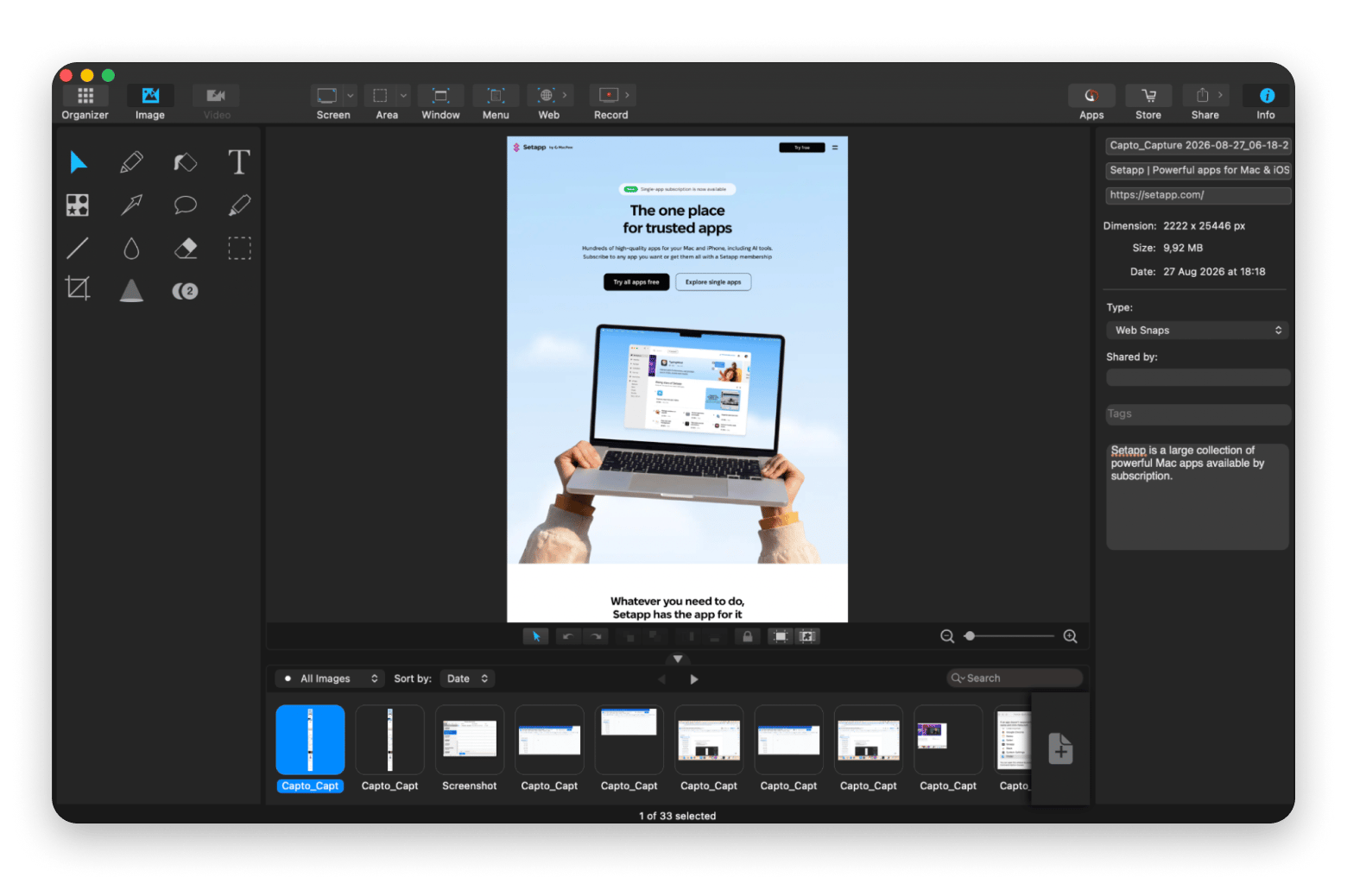
To capture a full webpage screenshot on Mac, use Capto. The app captures the entire page length automatically.
With Capto, you can capture the full length of a webpage in just a few clicks, then crop, annotate, and share your screenshot instantly.
This is how the scrolling screen capture works using Capto:
Open the web page you need to snap.
Launch Capto.
Click on the Capto icon in the menu bar.
Click Snap active browser URL.
You'll get a full webpage screenshot, which will be saved to the Library. From there, you can easily crop, organize, and share your screen capture. Capto is a great app if you're a creative professional, marketer, student, or someone who needs a robust screen recorder on Mac.
Why I switched to Capto: I’ve tried using macOS’s built-in tools to capture full pages, and honestly, they just don’t cut it. Shortcuts like Shift + Command + 3 or 5 are fine for quick grabs, but when I needed to screenshot a long webpage or a full chat, they only caught what was on my screen. So I found Capto
How to capture scrolling screenshots on Mac
Capto is a great app, but it only works with web pages. If you need to grab a scrolling part of an app interface or a text doc, Capto won't help you. For this, you'll need an app like CleanShot X.
CleanShot X is a universal screen-capturing app for Mac that comes with more than 50 useful features, including scrolling capture.
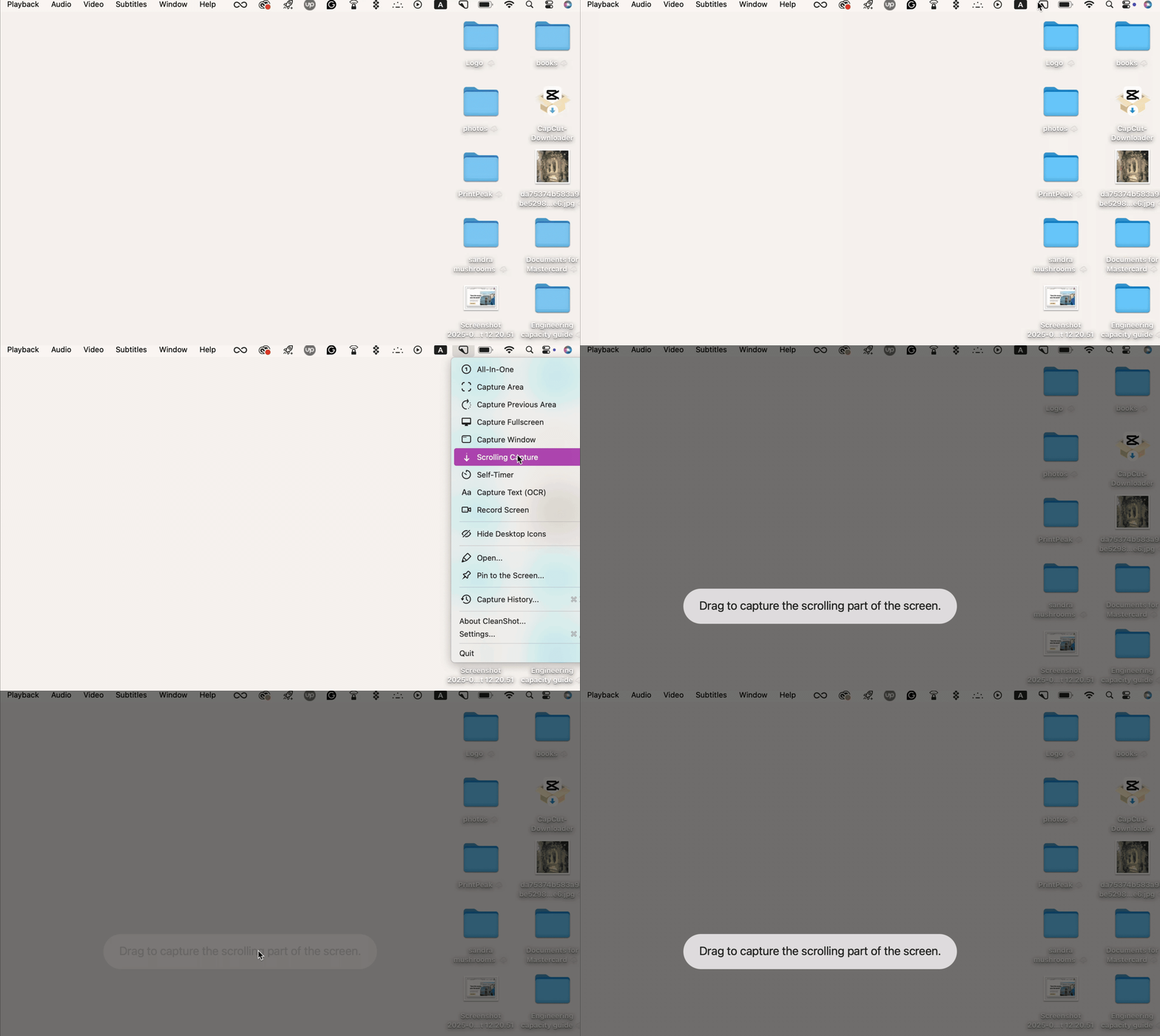
Here's how to use CleanShot X to save scrolling content:
Install and open the app.
Choose Scrolling Capture in the app menu bar.
Drag to select a scrollable area on your screen.
Click Start Capture and scroll down.
Click Done once you’ve captured the full scrollable area.
Open your screen capture from the overlay menu and edit if needed.
Share and edit your scrolling screenshots
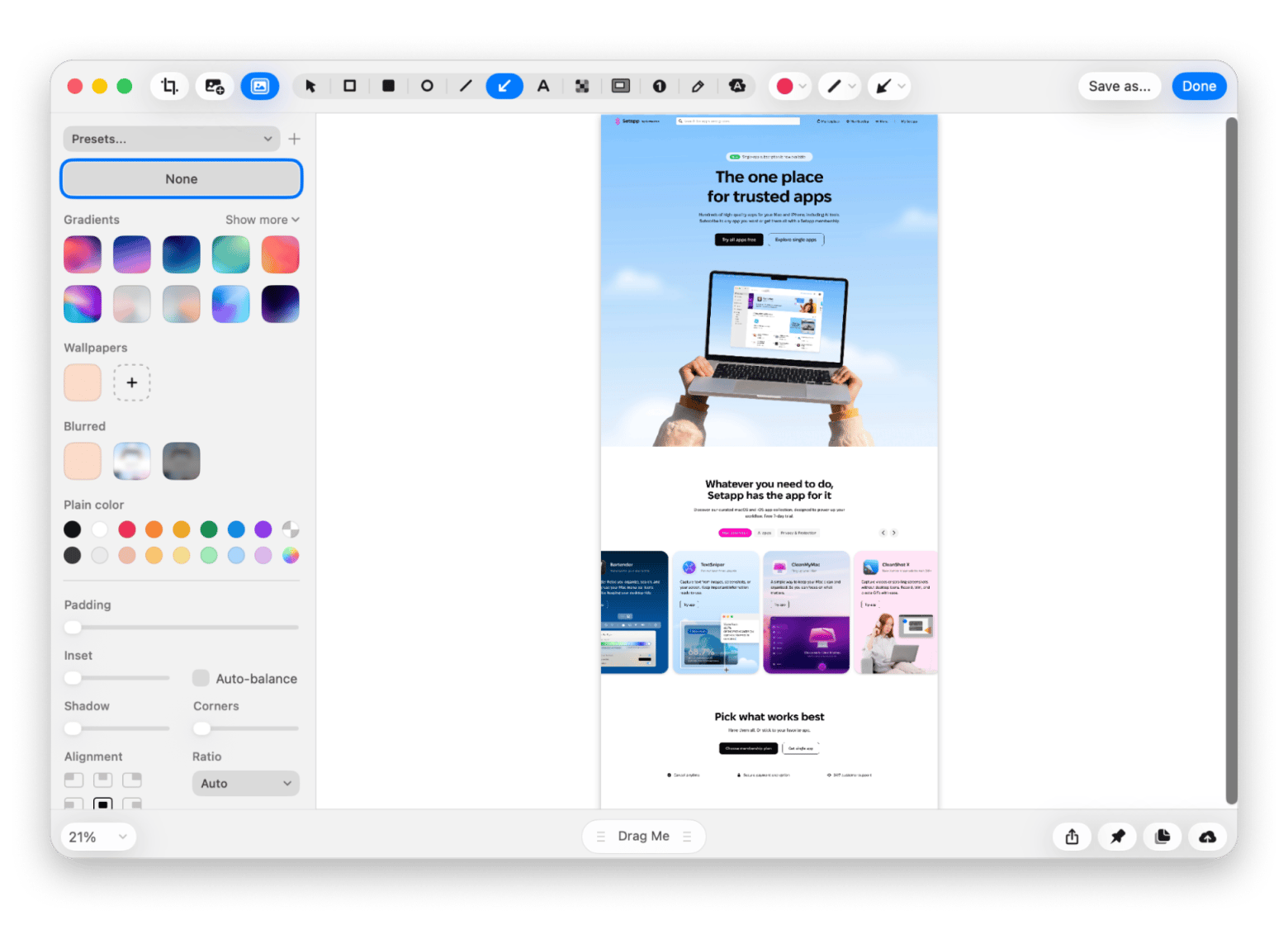
You can edit scrolling screenshots directly within CleanShot X.
Here's how to do it after you take a screenshot:
1. Click the Annotate icon in the bottom-left corner of the prompt that appears when you take a screenshot.
2. Choose from any of the features at the top of the window that appear, depending on your desired action.
3. You can highlight, crop, blur, or pixelate, number, add shapes, lines, and text, and even use the spotlight tool to select an area and dim its surroundings for emphasis.
4. Click the Save as button on the top-right side of the window after editing. This will also work if you want to export the screenshot in a particular format.
5. The app offers multiple export formats to match your workflow needs.
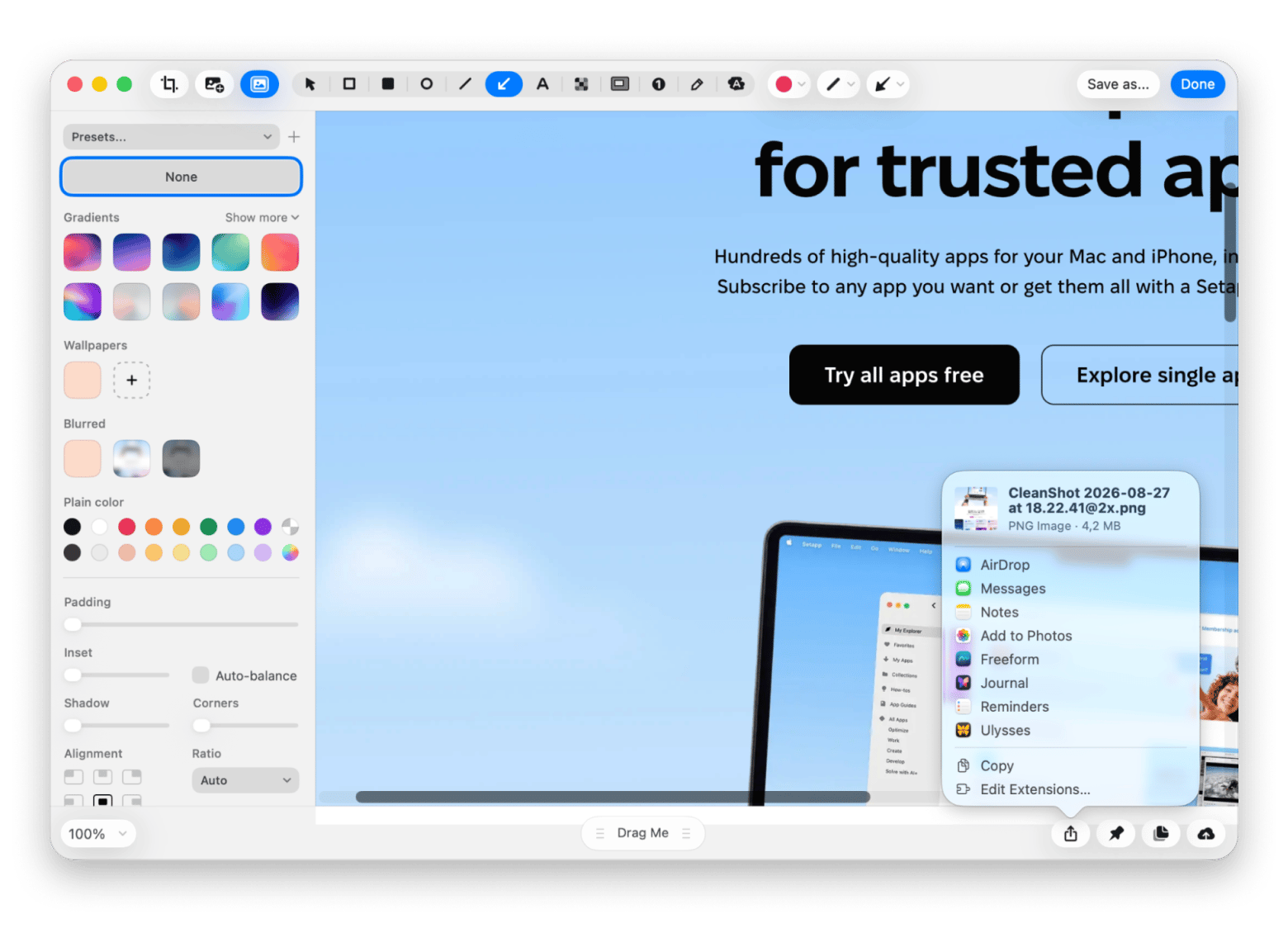
6. To share a screenshot using CleanShot X, simply right-click the prompt that appears after taking the screenshot or click the share icon below in edit mode.
What I usually do is click the Upload button at the bottom right of the prompt. This sends the screenshot straight to my CleanShot Cloud. It’s super helpful when I’m working with a team because we all have access to the same space. No more digging through email threads to find the right image.
One thing I wish I'd known earlier: CleanShot X's scrolling capture works best when you scroll at a steady, moderate pace. If you take it fast, the tool will ask you to slow down to avoid blurry screenshots.
Take a scrolling screenshot on iPhone or iPad
You can also take scrolling screenshots on your iPhone and iPad. All you need to do is choose Full page in your screenshot preview.
Here’s how it works on iPhone:
Take a screenshot:
For iPhones with Face ID: Press the Side button and Volume Up button simultaneously, then release them right away.
For iPhones with a Home button: Press and release the Side button and Home button at the same time.
Choose Full page.
Edit your scrolling screenshot if you want, then tap Done or Share.
This quick method will let you capture an entire document, file, email, note, or any content in an app or on the web. According to recent updates in 2026, you can now use the crop handles to select specific portions of the full-page capture before saving.
Capture your screen with keyboard shortcuts
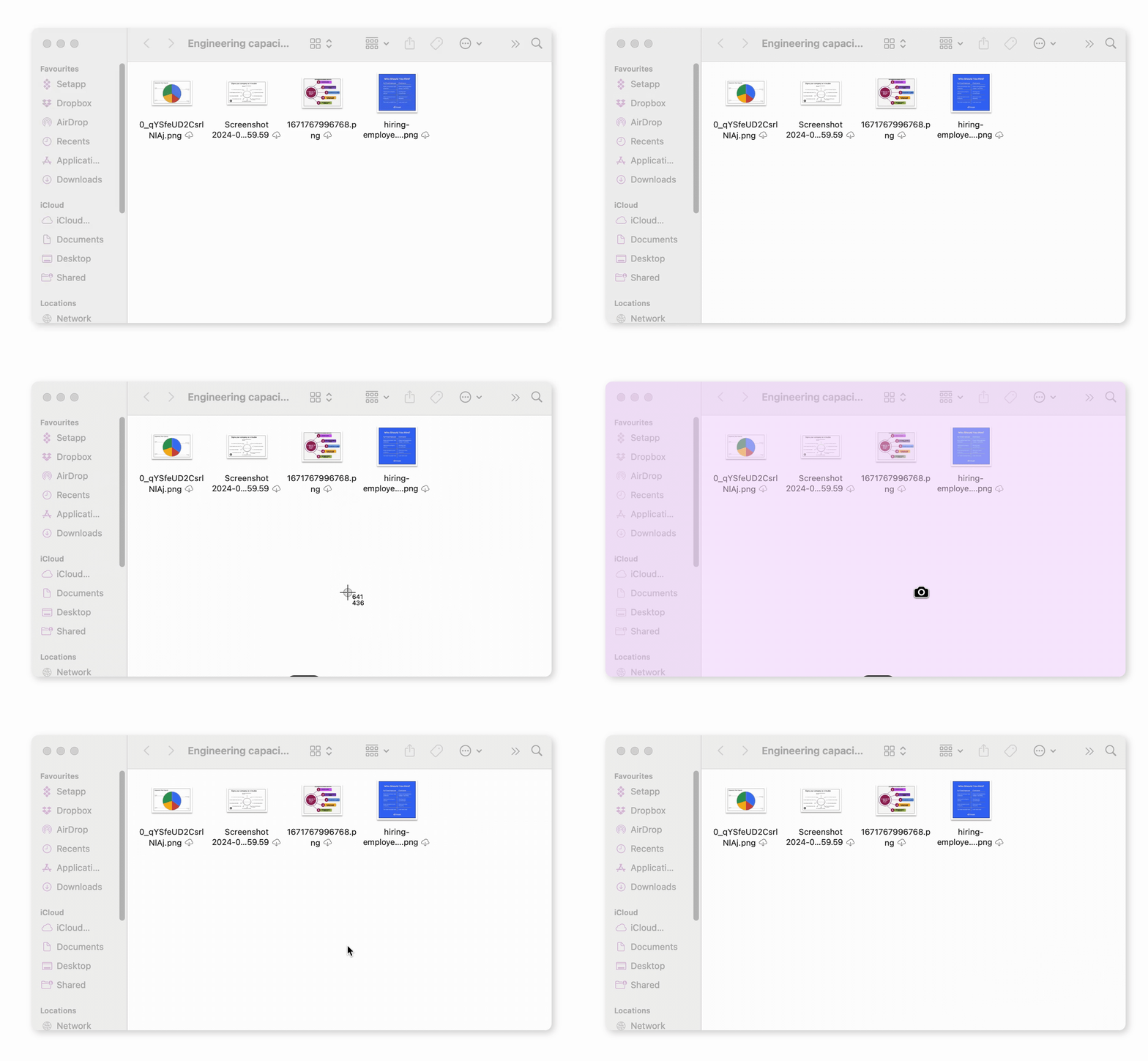
macOS includes built-in keyboard shortcuts for quickly capturing screenshots of your screen.
To capture the entire screen:
Press Command + Shift + 3. This will take a screenshot of your entire screen and save it to your desktop by default.
If you want to capture a selected area, press Command + Shift + 4. Your pointer will turn into crosshairs. Click and drag to select the area you want to capture.
Here's how to capture a specific window or menu:
Press Command + Shift + 4.
Tap the Spacebar. The cursor will change to a camera icon.
Click on any open window to capture it.
When I take a screenshot on my Mac using keyboard shortcuts, it shows up on my desktop as a PNG file. The filename includes the date and time, which makes it easy to find later. If I need to convert it to a JPEG or another format, I just do that afterward. For quick edits, like cropping or adding arrows, I usually open the image in Preview. That’s fine for simple stuff.
But when I need to capture a full webpage or something that scrolls, I’ve learned that built-in tools aren’t enough. In those cases, I use a third-party app to get the job done properly.
Built-in vs. third-party tools for scrolling screenshots
If your work involves regularly capturing content on your screen, it helps to understand the perks and downsides of both the built-in and third-party tools.
So, what are the perks, and what might hold you back?
Built-in macOS tools
What to like:
Free to use, no subscriptions or downloads needed
Quick and easy keyboard shortcuts
Accessible Screenshot toolbar for various capture modes
May consume more system resources (CPU, RAM, storage)
Learning curve for users unfamiliar with advanced features
Third-party apps offer significant advantages if you regularly capture long pages, annotate, blur sensitive information, or organize screenshots efficiently. Built-in tools suit occasional, simple screenshots.
Scrolling screenshot tips for different use cases
Here are practical tips based on your specific needs:
For project documentation and client work: Keep full context visible, including dates and page elements. When screenshots are used for project reviews, client presentations, or workflow documentation, having the complete page ensures accuracy and provides necessary context.
For content creators and social media: Use blur, pixelation, and cropping features before saving. This prevents accidentally sharing personal information in your screenshots.
For students and researchers: Capture full articles, papers, or tutorials. Organize them in folders with clear names for easy retrieval during study sessions.
For team collaboration: Upload screenshots to shared cloud folders like CleanShot Cloud or Dropbox. This ensures everyone accesses the same reference materials for product reviews, marketing approvals, or content planning.
For technical documentation: Keep raw copies of the full page. Include important details like dates, location, language settings, and disclaimers. This context helps with searches, publications, and follow-up responses.
Final word on full-page screen capture on Mac
If you're just looking to grab what's on your screen, macOS has you covered with its built-in shortcuts, which are great for quick, visible-only screenshots.
But let’s be honest, if you regularly need to capture long pages, annotate, blur sensitive info, or organize your screenshots neatly, third-party apps like Capto and CleanShot X are the way to go. They’re fast and packed with features that the native tools just don’t offer.
Screenshots that capture everything — visible, scrolling, and even the text inside images. CleanShot X for scrolling captures, Capto for full webpages, TextSniper for OCR text extraction. All part of Setapp — 270+ Mac and iOS apps, one subscription. Cancel before Day 7 — $0 charged. Try Setapp Free.
FAQ
How do I take a screenshot of a whole page on Mac?
Press Shift + Command + 3 to capture the visible screen. For full webpages, useCleanShot X's Scrolling Capture to manually scroll and capture, or Capto's Snap Active Browser URL to automatically grab entire pages. Both apps handle long content better than native tools.
How do I capture my entire Mac screen?
Press Shift + Command + 3. macOS saves a PNG of the whole display to your desktop. If you want a different location or format, open the image in Preview and use File > Export.
How do I record my Mac screen full screen?
Press Shift + Command + 5, pick Record Entire Screen, then click Record. When finished, hit the stop icon in the menu bar. macOS saves the video to your desktop.
How do I take a scrolling screenshot on iPhone or iPad?
Take a normal screenshot (Side + Volume Up, or Side + Home).
Tap the thumbnail.
Choose Full Page at the top.
Edit if needed, then tap Done > Save PDF to Files or use Share.
Can macOS built-in tools take scrolling screenshots?
No. macOS shortcuts only capture what's on the screen. To grab an entire webpage or chat, use third-party apps like Capto or CleanShot X.
Get Capto for screen recording
Record any part of the screen and edit video easily.






 Best solution
 Best solution