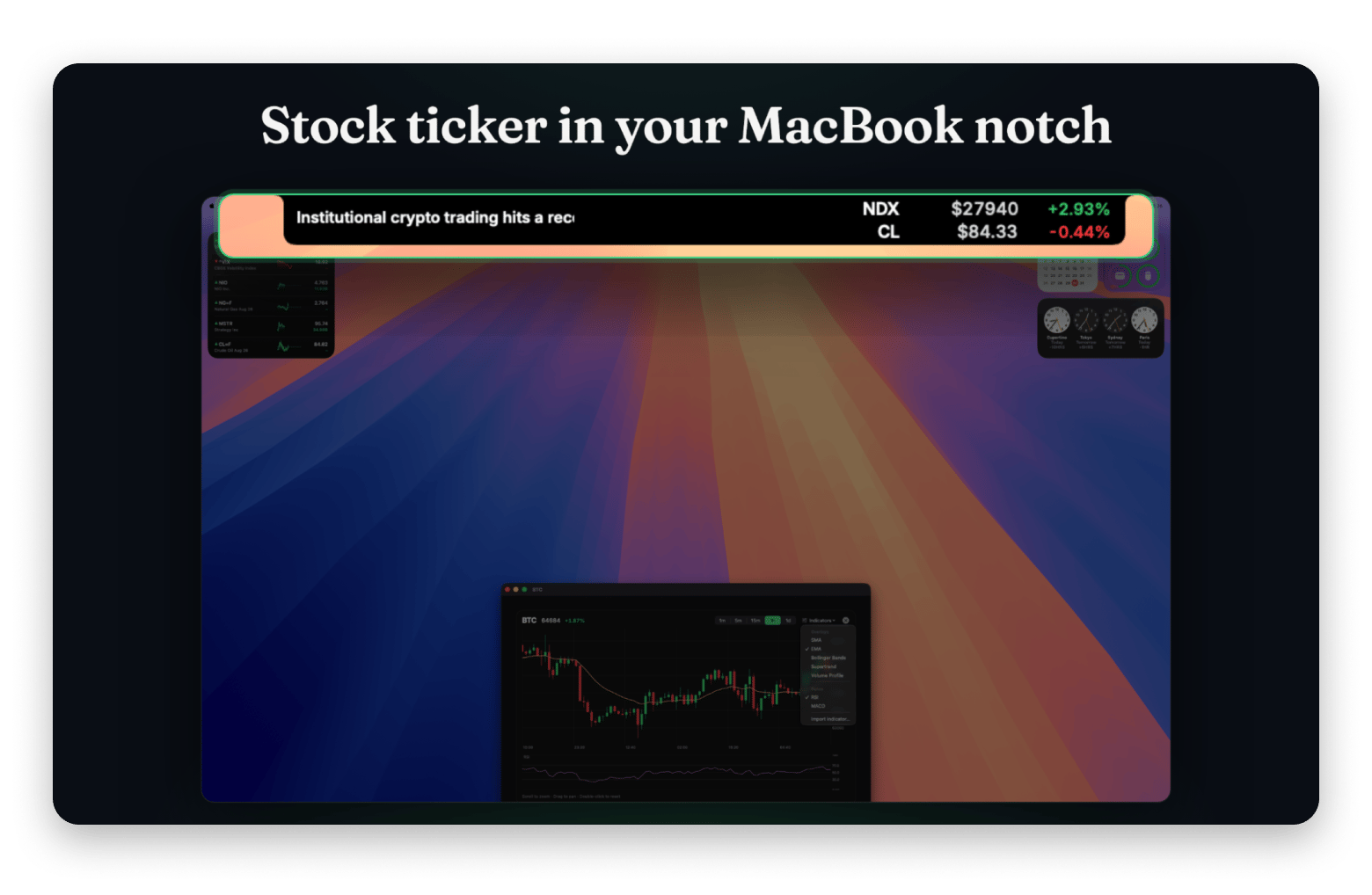
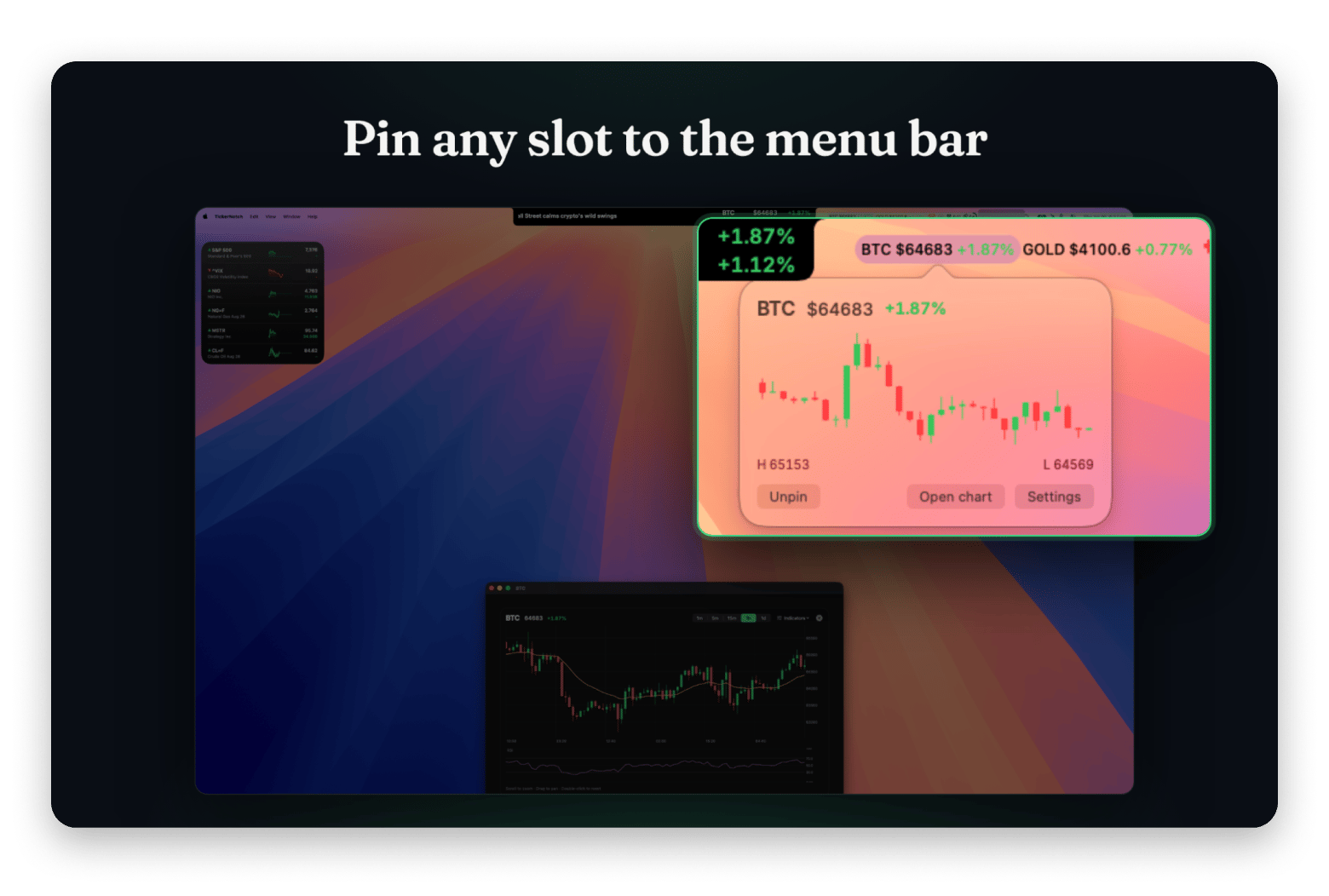
I was losing hours staring at charts and falling down news rabbit holes. I kept TradingView and a row of browser tabs open just to glance at prices and headlines, while the space beside the MacBook notch sat there doing nothing. So the idea was simple: keep the watchlist, the portfolio P&L, headlines and price alerts permanently in view in screen space nothing else uses, so I can stay in deep focus on real work and still know what the markets are doing.
My background is materials engineering, with a second master's in advanced informatics, and I have been trading the financial markets for about nine years. I have always lived in front of screens, digging through academic or financial research, and building my own tools grew out of that — they started as small personal projects to solve my own problems, and TickerNotch was the one I ended up building for other people, too.
Solo, all the way
From writing code to marketing, support, design, and the release pipeline—I did it all on my own.
The good side is that the person answering support wrote the code. The other side is that a launch week is a full project on its own, and nobody else is going to run it. I do get real outside input, though: several features exist because a reviewer or an early user asked for them, and I try to ship those fast.
In my day-to-day work, I use tools such as Xcode, Swift and SwiftUI, with a bit of AppKit for building, Sparkle for updates, Xcode Cloud for the App Store builds, GitHub for the code and the automated test suite.
For the business side: Cloudflare for the website, Gumroad and Dodo Payments as merchants of record so VAT is handled for me, Migadu for email. And Claude Code across all of it.
AI changed the way I work. I build with Claude Code as a pair programmer, and it wrote a meaningful share of the code. The architecture, the product decisions, the testing and the review of every shipped line are mine.
Where Claude actually helps: the tedious parts that still have to be right, like tests, refactors and release scripts, and digging through logs for evidence instead of guessing.
Where it does not: it will confidently build on a wrong assumption, and a green test suite means little if the tests check the wrong thing. The judgment and the responsibility stay with me. It changes the speed, not the responsibility, the same way earlier generations adopted Stack Overflow and modern IDEs.
Launching TickerNotch
The first public builds went out as a direct download from my own site, with Homebrew as the second install path. Product Hunt on 21 July was the first real launch, with a giveaway thread for early users. Two days later, AlternativeTo and Uneed went live on the same day. The Mac App Store followed on 9 August, Setapp on 13 August, and the iPhone sibling, TickerNotch for iPhone, on 20 August.
Launch day itself was mostly a reminder that being solo means you are the marketer, the support desk and the release engineer on the same afternoon. The launch week was its own project.
To find and attract users, I use several channels: my own site and the Homebrew tap, Product Hunt, a full review on MacSources that scored 97 out of 100, the directories (AlternativeTo, Uneed, SaaSHub, Softonic, Uptodown), small paid tests on Reddit and X, the Mac App Store, and now Setapp.
I honestly cannot say yet which ones actually brought users. The numbers are still too small for any conclusion that would survive a statistics class, and for a long time I could not even see them properly.
Why I brought TickerNotch to Setapp
Adding TickerNotch to Setapp seemed perfectly natural to me, as I had been a Setapp subscriber myself for almost a year before any of this, and I was very satisfied with what it offers: one subscription, a curated catalog, apps I would not have found on my own. Setapp users are exactly the people who already pay for good Mac software, and a listing puts the app in front of them without asking them to trust a new developer's website. The review process also made the app better: the real Help menu and the full user guide exist because Setapp's reviewers asked for them.
The privacy mistake that made me blind
I respected user privacy 100%, and it made me blind. TickerNotch launched with no analytics at all, no telemetry, no account, nothing. I was proud of that, and I still think the instinct was right. But it meant I had no idea how many people had actually installed the app, whether they kept using it, or which channel had brought them. I was judging launches and even ad spend on guesses.
The fix was a middle ground: an optional daily usage report with nothing personal in it, just the app and macOS version, the type of Mac and rough counts of what the strip is showing, under a random ID that one switch deletes. The lesson is that privacy and measurement are not opposites. Decide from day one what you need to know to run the product, collect exactly that, openly, and nothing more.
Shipping TickerNotch to iPhone
A month after launching TickerNotch for Mac, I brought the same idea to the iPhone. The Dynamic Island felt like a natural place for it: another piece of screen space that could show useful information without interrupting what the user was doing.
The concept had already started expanding beyond market data thanks to feedback from early users and reviewers. Nick Calderone from MacSources sent me an idea while testing: the strip should not only carry tickers. Weather, social counters, news on both sides. About 27 hours later that shipped as version 1.1.0, every phase of it, nothing cut. His review came out at 97 out of 100.
That update showed me that TickerNotch could be more than a market ticker. Shipping the iPhone app a month later allowed me to bring the same broader idea to the Dynamic Island.
My advice for new Mac developers
Build the thing you would keep running on your own Mac even if nobody bought it, because for a while nobody will. Sign and notarize from the first release so the download is tied to you from day one. Treat the launch as a separate project with its own week. And answer every support mail yourself early, because that is where the next feature comes from.






 Best solution
 Best solution