ScreenPlace has made around $1,000 since I launched it a few months ago. That's not a huge number, but it's mine — every dollar of it came from channels I found and tested myself, with no App Store algorithm doing any of the work for me. And that's exactly what makes this app different from everything I've built before.
This wasn't my first app
I am a developer and designer from Latvia, and the founder of DesignTech. I originally started out as a designer, but I always wanted to know how those apps and websites I was designing were actually built. Being a big fan of Apple's products, both hardware and software, I decided to pick iOS as the platform to learn to code for. I downloaded Xcode more than 7 years ago and started learning Swift. It was extremely difficult — I couldn't understand anything, and I almost gave up, but I kept on trying because I just couldn't stop dreaming about building my own apps that can help other people with their various day-to-day tasks.
I've built multiple apps over the years, but the most successful of all is Doneit, a task manager for projects of any complexity, with list, grid, kanban, and timeline views. Doneit is a very special app to me because it was literally the first one on my journey to learn to code. I started working on it in 2019 and released the first version in January of 2021. I nearly gave up on it a dozen times, but when I released it, it did reasonably well on Product Hunt and was featured by Apple on the App Store a few weeks later.
That experience taught me how to build. ScreenPlace is teaching me something different.
The building side got solved first
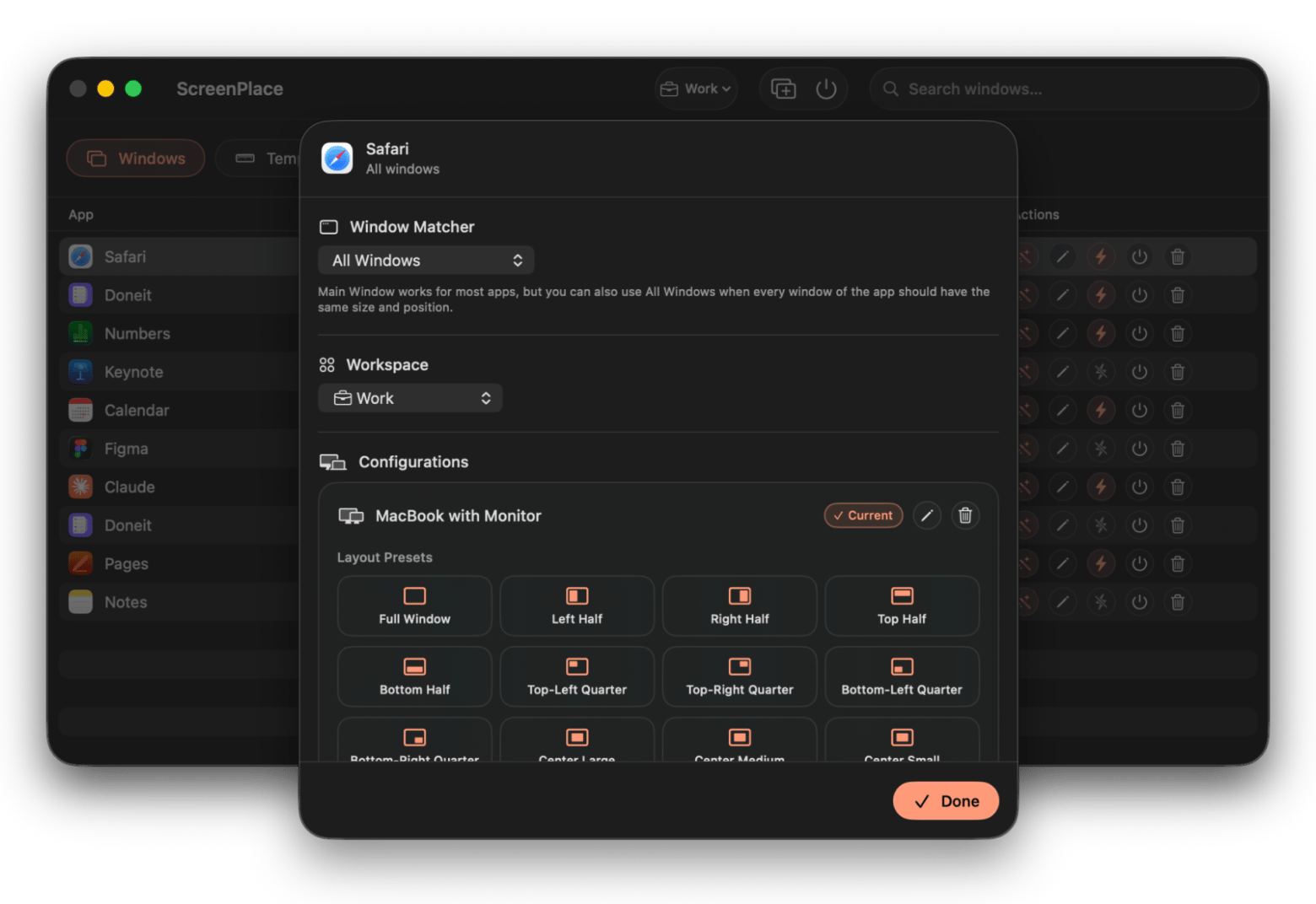
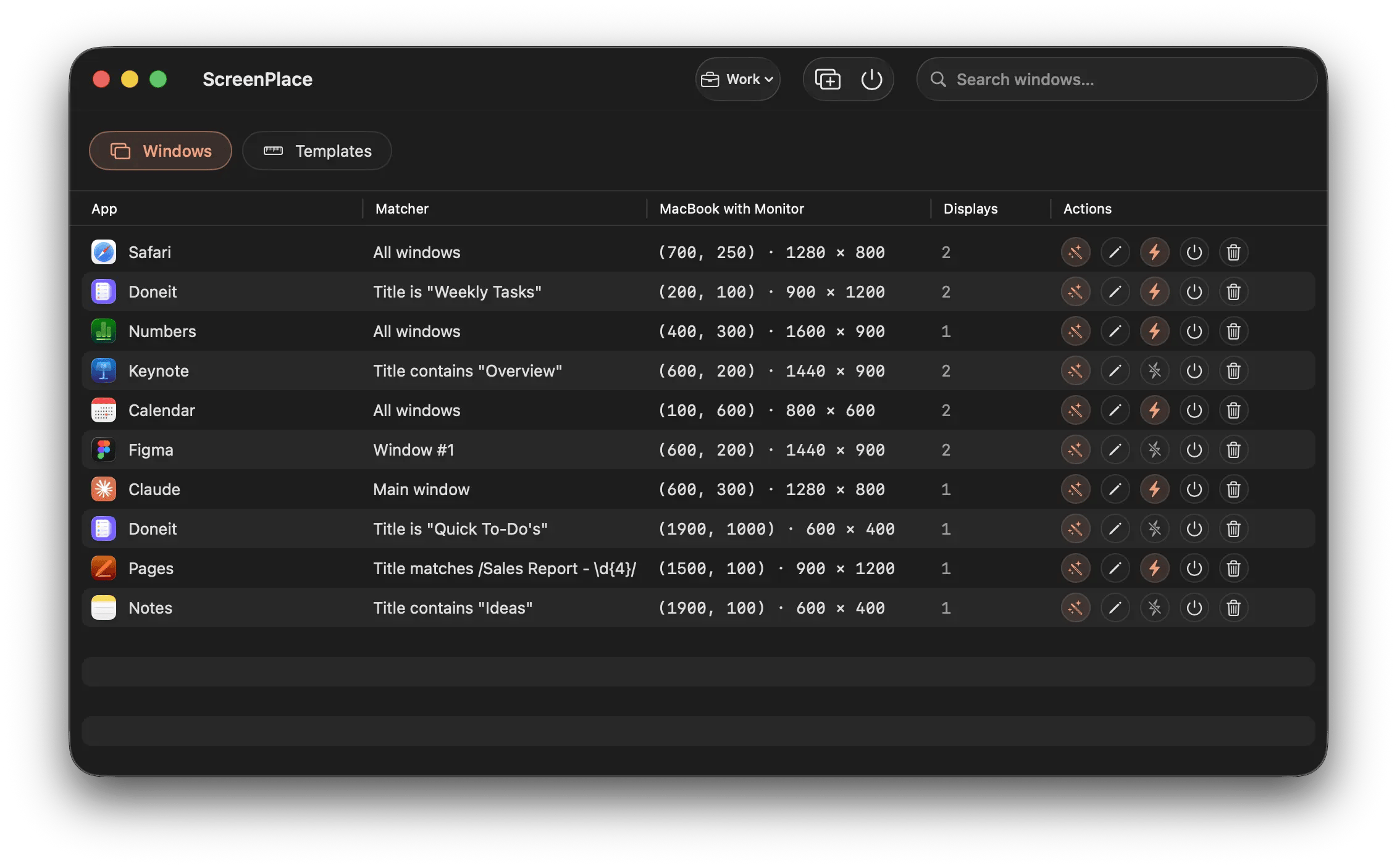
ScreenPlace itself came from a spontaneous, unplanned moment. I always used to work on a laptop and never really needed a window manager, but when I got a monitor earlier this year, having most of my windows taking an entire screen wasn't ideal on a larger display. The real frustration came every time I reconnected my MacBook to a monitor and window sizes and positions would change — that's the idea behind ScreenPlace: put every window in its place, automatically.
I built it around two features I knew I needed. Badge is a floating companion for every window with an option to resize and snap it back into place with one click. And the auto-apply options are what I use the most — every morning I open my MacBook connected to a monitor and all of the windows are already exactly where I want them.
What made building this fast was AI. I remember when I first tried ChatGPT in early 2023, its answers to my SwiftUI questions were a bit outdated, so I mostly used AI for lighter tasks like summarization and ideation, not actual app code. That changed in early 2026, when Apple introduced agentic coding in Xcode. I tried it and was genuinely surprised — I could build new features faster, improve performance, and fix tricky bugs more easily. Instead of shipping a rough MVP and iterating slowly, I could build polished features right away.
Distributing without the App Store is a different game
ScreenPlace is my first app fully distributed outside of Apple's App Store. That means no feature nomination form, no built-in discovery — I have to learn and do all of the marketing myself.
So I'm treating it the same way I once treated learning Swift: as a skill to build, not a wall to hit. I've been testing directories, sponsoring a few websites and newsletters, and running SEO. Some of the directories and sponsorships have already produced very good results. SEO, on the other hand, made almost no difference — based on my analytics, only a handful of visits came from search engines. Now I'm exploring content marketing and considering paid ads.
If there's one thing I'd tell myself before starting ScreenPlace, it's this: understanding how you'll market an app is worth figuring out before you start building it, not after. I didn't think much about marketing while I was building, and the first few weeks after release were a real crash course. But that's exactly what's shaping how I approach growth now — one channel at a time, based on what the data actually shows me.
What's working, and what's next
I don't have a fixed marketing strategy yet, and I'm still testing what works best. What I do know is that the app itself keeps getting better — I've already released quite a few updates with new features and improvements — and the users who've found ScreenPlace so far like what they see. I'm optimistic that once I land on the right marketing approach, the revenue will follow.
Why I keep going
I recently got feedback from a user saying ScreenPlace is great, and that none of the other window managers they've tried have come close. I enjoy getting feedback from users and hearing how my apps help them, as well as their suggestions for improving them. Honestly, that's what keeps me going — it's the main reason I started building apps in the first place.
My advice for anyone starting out building Mac apps: with the rise of AI tools, it's more important than ever to build polished apps that not only solve a specific problem, but delight users and create that magical feeling. I use ScreenPlace every day, and it still impresses me every morning when I connect my MacBook to a monitor. For a split second, my windows are all in the wrong place — and then, automatically, they're not. Isn't that magical?






 Best solution
 Best solution