- Two models, one platform:
Setapp Marketplace sells your app directly to any user, while Setapp Membership puts it in a subscription catalog with usage-based payouts.
- Marketplace revenue:
You set the price and keep 85% of subscription revenue or 75% of one-time purchases, calculated after tax.
- Membership revenue:
Setapp distributes 70% of subscriber fees by app usage, and the Partner Program adds a 20% fee for users you refer, up to 90% total.
- Eligibility differs:
Marketplace currently covers macOS and web apps from developers in Australia, Canada, the EEA, Switzerland, the UK, and the US.
- Start with Setapp:
Stop relying on search rankings and ad spend alone to get your app discovered. Start your submission →
Setapp is a curated app platform from MacPaw with 300+ apps for Mac, iOS, and the web. If you’re a developer considering it, the terms Membership and Marketplace can be confusing at first.
Setapp Marketplace lets you sell your app directly to any user and keep 85% of subscription revenue or 75% of one-time purchases, after tax. Setapp Membership adds your app to a subscription catalog and pays you from a 70% usage-based pool, with up to 20% more for users you refer. Choose Marketplace for pricing control and Membership for built-in discovery.
Let’s break down what each model offers and which makes sense for your app.
What is the difference between Setapp Marketplace and Setapp Membership?
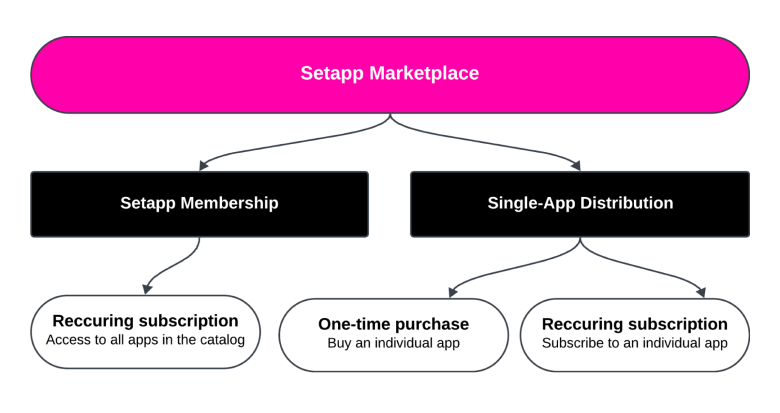
Marketplace is Setapp’s model, where users buy an individual app. It can be a one-time purchase or a subscription, and users don’t need a Setapp subscription. It’s more like the App Store.
Setapp Membership puts your app under Setapp’s subscription catalog. All Setapp subscribers can access the app, and they pay a monthly fee distributed to developers based on app usage rather than downloads or individual purchases.
The two models are independent, but they can also complement each other. You can choose the one that fits your business or offer your app through both.
For both models, Setapp handles licensing, payments, tax management, and first-line customer support. You get a developer dashboard for analytics and reporting, and you can still continue distributing your app through other channels.
Which apps can join Setapp?
Setapp vets all apps to ensure only the highest-quality products join the catalog.
The platform automatically rejects apps that:
- Are free outside Setapp
- Include hidden paid features
- Feature built-in stores or in-app purchases
- Contain advertising
- Run background processes without user consent
- Transmit user data without permission
- Attempt to discover passwords or private data
Setapp then subjects apps that pass these initial checks to two review levels.
The first is automated screening against malware databases from leading security vendors. Setapp review specialists then conduct manual inspections, check permission requests, analyze defense-evasion techniques, and ensure all access requests are justified by legitimate app functions.
Learn more about the process in the Setapp review guidelines.
Which platforms does Setapp support?
Setapp supports macOS 13.0 and later, iOS 12.0 and later, iPadOS 12.0 and later, and web apps. visionOS support is partial. tvOS, watchOS, Android, and Windows aren’t currently supported.
How does Setapp Membership work for developers?
Setapp Membership is the original way developers distribute their apps through Setapp. Your app joins a curated catalog that paying subscribers can access. Subscribers pay from $14.99 USD/mo to $22.99 USD/mo + tax, and most of that is distributed to developers.
To see how this looks from the buyer’s side, read the guide on single-app subscriptions vs Setapp Membership.
How do developers earn on Setapp Membership?
Setapp distributes 70% of the total subscriber revenue to developers based on usage (not downloads), relative to the total catalog. If you join the Partner Program and bring new subscribers to Setapp, you earn an extra 20% Partner fee on their subscriptions. That brings your total share to up to 90%.
Setapp commission is only 10%.
Here’s how the math works out for each subscriber on the base plan ($14.99 USD/mo + tax):
Allocation | Amount |
Developer pool (usage-based) | $10.49 USD |
Partner fee (referrals) | $3.00 USD |
Setapp commission | $1.50 USD |
To allocate the developer revenue, each app in the catalog is assigned a price tier based on its market price outside Setapp, and each tier has a multiplier.
For example, apps priced between $1 USD and $1.99 USD receive a multiplier of 1. Apps that cost between $4 USD and $5.99 USD are assigned a multiplier of 3, and so on.
Revenue is then determined using the formula:
Monthly payout per customer = usage revenue × (your app's price coefficient ÷ sum of coefficients for active apps)
Let’s say a Setapp subscriber pays $14.99 USD and opens the following apps during one billing period:
App | Price tier | Multiplier |
A (your app) | 7 | 10 |
B | 10 | 20 |
C | 1 | 1 |
If you referred this user to Setapp, you automatically earn 20% in affiliate revenue:
$14.99 USD × 20% ≈ $3.00 USD
Then, you get your share of the developer revenue, which is distributed based on the apps a particular subscriber used:
In this case, the total multiplier sum is:
10 + 20 + 1 = 31
Your share from the 70% distribution:
($14.99 USD × 70%) × (10 ÷ 31) ≈ $3.38 USD
To earn the usage-based share, a subscriber needs to open your app during that billing period. The Partner fee doesn’t depend on usage.
Full plan details are covered in Setapp pricing explained.
What makes Membership different?
When you list your app on Setapp, you expose it to a built-in subscriber audience. It’s immediately accessible to paying Mac users who are actively looking for apps.
The Setapp team then takes over to introduce your app to its audience. Each new app benefits from paid ads, SEO optimization, content marketing, email marketing, and social media marketing. Users can also find it through the product surfaces inside the Setapp client.
For developers, this means that your app discovery doesn’t rely entirely on search rankings, your own advertising budget, or an existing audience. On average, an app generates around 30k unique impressions in the first days of its Setapp release. You can then enjoy a continuous stream of revenue because Setapp subscribers are loyal to the brand and pay monthly.
Plus, you get automatic updates, and there are no sandbox restrictions like in the Mac App Store.
What developers say about distributing through Setapp
"I really like distributing ScreenPlace on Setapp because once I integrated the framework into the app, everything else is just so effortless. Submitting a new build takes no time, and the review process is very efficient.”
— Daniils Minonoks ScreenPlace
“Adding TickerNotch to Setapp seemed perfectly natural to me, as I had been a Setapp subscriber myself for almost a year before any of this, and I was very satisfied with what it offers: one subscription, a curated catalog, apps I would not have found on my own [...] The review process also made the app better: the real Help menu and the full user guide exist because Setapp's reviewers asked for them.”
— Ioannis Farmakis, developer of TickerNotch
How does Setapp Marketplace work for developers?
Setapp Marketplace is a newer model that lets developers sell apps directly to individuals, whether or not they're Setapp subscribers. Developers can offer their apps via a subscription model or as a one-time purchase app, whichever fits their business.
Sell your app on its own terms
Setapp Marketplace gives you more control because you can set your own price.
If you want to use a subscription model, you can offer monthly, 3-month, 6-month, or annual subscriptions. You can also add an optional 7-day free trial for subscription apps (contact Setapp to enable it). Users must provide a credit card to start it. You keep 85% of each subscription payment after tax.
If your app works better as a one-time purchase, you can offer that instead. You keep 75% after tax, and buyers keep long-term access to the app.
What developers get with Marketplace
Setapp Marketplace gives you pricing flexibility because you don’t depend on Membership’s usage-based revenue model. You also gain visibility through MacPaw’s products, websites, and landing pages.
Besides Setapp subscribers, you can reach a wider audience that prefers to buy or subscribe to one or two apps instead of paying for a catalog.
If you’ve already listed your app on the Mac App Store, you also get a chance to reduce the one-channel point of failure. A rule change, an algorithm shift, or an update rejection can tank your revenue overnight. Setapp provides a safety net and more stability.
With Marketplace, Setapp still provides first-line customer support for billing, licensing, and refunds. Consider it for niche tools, higher-priced utilities, and other apps whose pricing doesn’t fit the bundle model.
Is your app eligible for Marketplace?
Marketplace is currently available for macOS and web apps, with iOS Marketplace planned for later in 2026. The initial developer rollout is limited to developers based in Australia, Canada, the European Economic Area, Switzerland, the United Kingdom, and the United States. More regions are planned.
If you're interested in joining, contact [email protected] to discuss your app. You can also review the Single App Distribution overview for the current requirements.
Setapp Marketplace vs. Setapp Membership: how do they compare?
The two models differ in who can access the app, the revenue model, and control, among other factors.
Here’s a breakdown:
Factor | Setapp Marketplace | Setapp Membership |
Who can access your app | Anyone who buys the app | Active Setapp subscribers |
Revenue model | Per-app purchases or plans | Usage-based subscription share |
Revenue share | 85% (subscriptions) | 70% by usage, +20% referral |
One-time purchase share | 75>#/p### | N/A |
Pricing control | You set the price | Based on usage and price tier |
Catalog | Individual app listings | Curated collection of apps |
Free trial | Optional (subscriptions only) | 7-day free trial |
Billing and support | Handled by Setapp | Handled by Setapp |
Platforms | macOS and web (iOS planned) | macOS, iOS, iPadOS, and web |
Other distribution channels | Non-exclusive | Non-exclusive |
Can you use both? | Yes, if eligible | Yes, if eligible |
Both models work well on Setapp, but they suit different business and operational goals. Evaluate your business and revenue preferences to determine the approach that makes more sense for your type of app, target audience, and revenue strategy.
How to choose the right model, or use both
The right distribution model requires thinking beyond revenue alone. Consider how the app fits into people’s Mac life, how your target audience prefers to pay for software, and what you want your business model to look like.
Here’s a quick starting point:
If your priority is… | Consider… |
Reaching multi-app users | Setapp Membership |
Selling a niche tool directly | Setapp Marketplace |
Earning from ongoing app usage | Setapp Membership |
Setting your own price | Setapp Marketplace |
Serving varied buying habits | Both, if eligible |
How do your customers prefer to pay?
If your target audience works better with six, seven, or more premium tools, they likely prefer to pay for an entire catalog. If they often use specialized tools, Setapp Marketplace lets them buy or subscribe to each app individually.
How does your app deliver value?
Apps people return to often can benefit from Membership’s usage-based revenue. A task manager, a clipboard tool, or a meeting assistant is a practical example.
If the app is used only occasionally, such as some utility tools, it can benefit from its own listing and price.
How predictable does your revenue need to be?
Marketplace subscriptions can be a bit more predictable than Membership listings. However, increased popularity on Membership can significantly boost a developer’s earnings. Think about the model that fits your business and the revenue dynamics you are comfortable with.
How will people discover your app?
Setapp Membership apps benefit from inclusion in Setapp’s curated catalog and have more opportunities for discovery through the platform’s content and marketing channels. Users in this category like to discover new tools they didn’t even know they needed.
Setapp Marketplace gives apps an individual listing for customers looking for a specific tool. Consider how your target audience searches for software.
Can you offer both?
Potentially. Distributing your app through both models gives customers different ways to access your app. However, don’t assume that an app qualifies for both. Confirm eligibility with Setapp before planning around dual distribution.
Find the right Setapp distribution model for your app
Membership uses a usage-based revenue model. It works well if you want instant visibility and a continuous revenue stream. Marketplace gives you more control through direct sales. You can offer a subscription or a one-time purchase. You can also use both models if your app is eligible.
If this sounds like a fit, reach out and discuss your app and the next steps with the Setapp team.
You know the models. Now pick yours and start your Setapp review. Earn from usage, sell direct, or do both if your app is eligible. Setapp handles billing, licensing, tax management, and first-line support. Start your submission.
FAQ
What is the difference between Setapp Marketplace and Setapp Membership?
Setapp Marketplace lets developers set their own prices and sell directly to users, either through a subscription or as a one-time purchase. Setapp Membership lets developers add their app to a curated catalog and earn revenue based on their app usage, not downloads. The main differences are how users access the apps, the pricing control, and revenue distribution.
Can I distribute my app on Setapp and the Mac App Store at the same time?
Yes. Setapp is non-exclusive, so you can distribute your app on Setapp and continue distributing it through other channels, including the Mac App Store. This makes Setapp an additional revenue option, as it exposes developers to users who prefer accessing apps through a catalog rather than paying individual subscriptions.
How does Setapp's revenue share compare to the App Store?
Setapp Marketplace developers receive 85% of subscription fees and 75% of one-time purchases, after tax. Under Setapp Membership, developers receive 70% of subscriber fees based on usage, plus a 20% Partner fee for users they refer, up to 90% total. The standard Mac App Store commission is 30%, or 15% for qualifying developers under the App Store Small Business Program.
What is Setapp Marketplace, and how do I join?
How does Setapp handle billing and user support for my app?
The Setapp Framework handles licensing for apps under both Setapp Membership and Setapp Marketplace. Setapp handles billing and tax management, including VAT for international sales, and provides first-line customer support for billing, licensing, and refunds. For Membership, taxes are added on top of the subscription fee. For Marketplace, the price you set includes tax, and your share is calculated after tax is deducted.






 Best solution
 Best solution