ASO is the highest-ROI free channel. Optimizing your app's title, keywords, screenshots, and description directly drives organic installs — no budget needed.
Referral programs outperform paid acquisition. Built-in referral features generate 20–35% of installs in mature programs, with referred users showing 37% higher Day-30 retention.
Short-form video and UGC move the needle fast. TikTok and Reels content with 65%+ completion rates, plus user-generated campaigns, produce 6.9x more engagement than branded content.
Community compounds over time. Discord and Reddit groups boost retention by 40% and engagement by 35% — and keep working long after you stop posting.
Platform distribution can replace your entire ad budget. Listing on Setapp puts your app in front of an existing, high-intent audience from day one — no ad spend, no cold traffic.
Platform distribution gives developers a head start. Grow your app with Setapp — reach an existing audience of Mac users from day one, with no ad spend required.
I've written hundreds of app reviews, and one question kept nagging at me: how do developers compete in a market this saturated without burning money on ads?
There are millions of apps across the App Store and Google Play. Most of them are invisible. So I started digging — reading everything I could find, and talking to developers who'd figured out growth without a paid acquisition budget.
What I found surprised me. The channels that actually work aren't exotic. They're just underused. Here's what the best indie developers are doing to advertise their apps without paid ads.
Why paid ads aren't the only path
Most app marketing advice defaults to "run some Facebook ads" or "try Apple Search Ads." Both can work — but both require a budget, ongoing optimization, and a cost-per-install that spirals fast if the onboarding isn't tight. For indie developers and small teams, that math rarely works in their favor.
The smarter alternative is to build channels that compound: organic search, referrals, content, community, and platform distribution. These take longer to spin up, but unlike ads, they don't stop working the moment you pause spend.
Optimize for app store search first (ASO)
App Store Optimization is the single highest-leverage free action a developer can take. Around 65% of users discover apps through store search. If a listing isn't optimized, the app is invisible before anyone even hears about it.
“App Store Optimization is free and your biggest lever. Use free tools like AppTweak or Sensor Tower's free tier to research keywords. Optimize your title, subtitle, description, icons, and screenshots. Good ASO alone can get you into search results and browse sections”, shares Darko Bačić, founder of AppTube Studios, on Reddit.
The elements that matter most:
Title and subtitle — include the primary keyword naturally.
Keywords field (iOS) — 100 characters of terms users actually search. Don't repeat words from the title; use adjacent terms.
Description — the first three lines are visible before "More." Lead with value, not features.
Screenshots — these drive conversions more than any other element. Show the outcome, not the interface.
Beyond the store, adding schema markup to the app's website can increase click-through rates from search results by 20–30% — more traffic reaching the store page without any additional spend.
“Referral programs can be really effective for getting users without big ad spend. You can use platforms like Partnero to manage them easily, or even start simpler with unique promo codes or tracking links you handle yourself”.
The best-performing referral programs generate 20–35% of total installs — and those users stick around. Referred users show higher Day-30 retention than users acquired through paid channels, and the ROI on well-designed referral programs averages 5–8x.
The mechanics are straightforward: give users something worth sharing for, and make the sharing action frictionless.
“The key is to shift from paying for attention to earning it. Since your users love the product, lean hard into word-of-mouth and trust-based channels. Start by setting up a simple referral system, even just gifting small perks for users who bring in others. People trust other users more than any ad”, shares a Reddit user.
Dual-sided incentives — give something to both the person sharing and the friend they invite. If only one side gets a reward, most people won't bother.
Tie the reward to the app — offer extra storage, a free month, or a locked feature rather than cash. A reward that makes the app more useful reminds people why they're sharing it in the first place.
Pick the right moment — ask users to share right after they've had a genuinely good experience with the app. Don't bury the referral prompt in onboarding before they've even seen what the app does.
Create content that spreads
Short-form video
TikTok and Instagram Reels have created a distribution channel where a single video can reach hundreds of thousands of people with zero ad spend. The catch: it has to be actually watchable.
Reddit and community posts
A single Reddit post in the right subreddit can spike your daily active users overnight. The key is to lead with genuine value — share something interesting, useful, or surprising, and let the app be the natural follow-up. Hard-selling in communities backfires fast.
User-generated content
UGC consistently outperforms branded content: 6.9x more engagement, 74% higher conversions. No formal campaign needed to get it started — the best approach is to ask engaged users to share how they use the app, feature their posts in official channels, and make it easy to tag the account.
Grow a community before you need one
Discord servers, Reddit communities, and in-app forums do something ads can't: they create a reason to come back. Apps with active communities see higher retention and higher engagement compared to apps without them.
The growth strategy that works best: put 80% of community content on searchable topics (tutorials, tips, use cases) so new members find it through Google or Reddit search rather than requiring constant outreach.
A small, engaged community also becomes the most reliable feedback loop, the most credible product advocates, and the most durable marketing asset a developer can have.
Email: build the list before you need it
Email has some of the highest conversion rates of any marketing channel — industry benchmarks put open rates at 22–28% and conversion rates at 5–10%for well-maintained lists. The catch is that a list you build after launch is worth a fraction of one you build before it.
The simplest pre-launch move is a landing page with an email capture. It doesn't need to be elaborate — "sign up to get early access" is enough. Anyone who signs up is telling you they're interested enough to wait. That's a warm audience ready to download on day one, before a single ad has run.
Post-launch, the goal shifts to keeping that list alive. A newsletter works when it shares something genuinely useful — tips, behind-the-scenes decisions, honest reflections on what's working — not just update logs. The developers I've spoken to who do this well treat their newsletter readers like early collaborators, not a distribution list.
“Building engagement with your app users sounds like a fun challenge! I’d suggest starting with a series of personalized emails. Maybe kick off with a warm welcome, followed by helpful tips, and then some sneak peeks of upcoming feature”, suggests a Reddit user.
Partner with micro-influencers and complementary apps
Influencer marketing doesn't have to mean paying a celebrity. Micro-influencers — creators with 10,000–100,000 engaged followers in a relevant niche — often deliver better results than larger accounts at zero cash cost, especially when offered early access, exclusive features, or revenue sharing instead.
The best place to start: look for apps the target audience already uses alongside yours. A focus timer developer should find a task management or note-taking app with an overlapping audience. A photo editor should look for a file manager or cloud storage app. The adjacency is the point.
Distribute your app on Setapp
There's one channel I don't see discussed enough in app marketing conversations: the platform you distribute on.
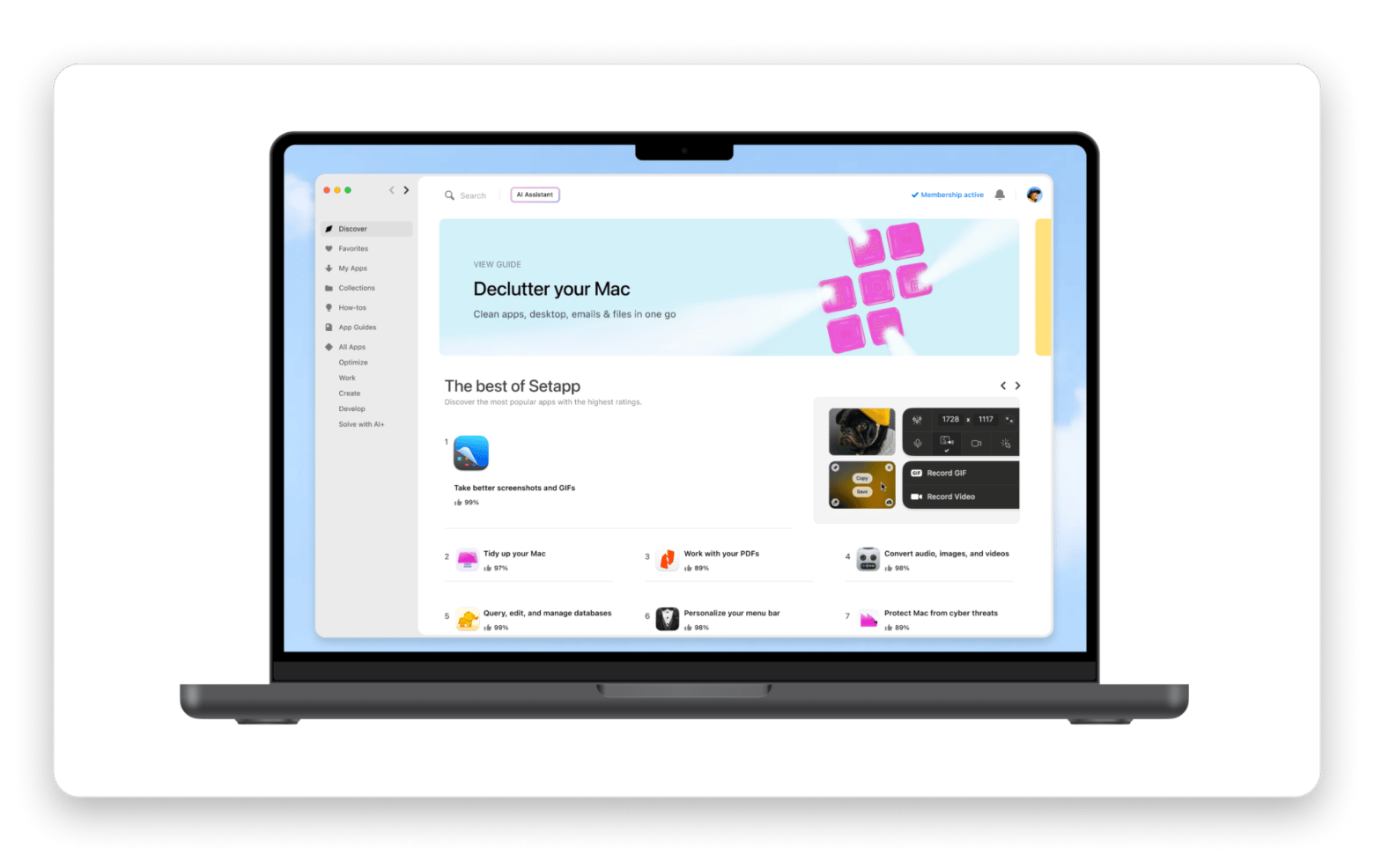
When a developer lists their app on Setapp, they're not just adding a new purchase option; they're plugging into an existing audience of Mac users who are actively looking for quality apps. Setapp handles distribution, discovery, and payment infrastructure. Apps appear in curated collections, search results, and recommendation surfaces that reach subscribers who are already exploring and spending.
"The first month with Setapp was a game changer. 75% of the total app revenue came from Setapp, while the App Store was generating just 25% at the time. First month I joined Setapp, Session made exactly the number I promised myself to quit all job/contract work."
Start with ASO — it's free and compounds over time. Then add a referral loop, a short-form video presence, and a community. These channels require time, not money, and they build on each other.
What's the best way to promote an app organically?
ASO combined with a referral program is the highest-ROI combination for most apps. Platform distribution, like Setapp, adds immediate access to an existing paying audience without needing to build one from scratch.
How long does organic app promotion take to work?
ASO improvements typically show results within two to six weeks. Community and email take three to six months to compound meaningfully. Referral programs reach real scale after one to three months with a solid base of engaged users.
Powerful apps live on Setapp
Ditch defaults and discover new gems on one app platform.





 Best solution
 Best solution