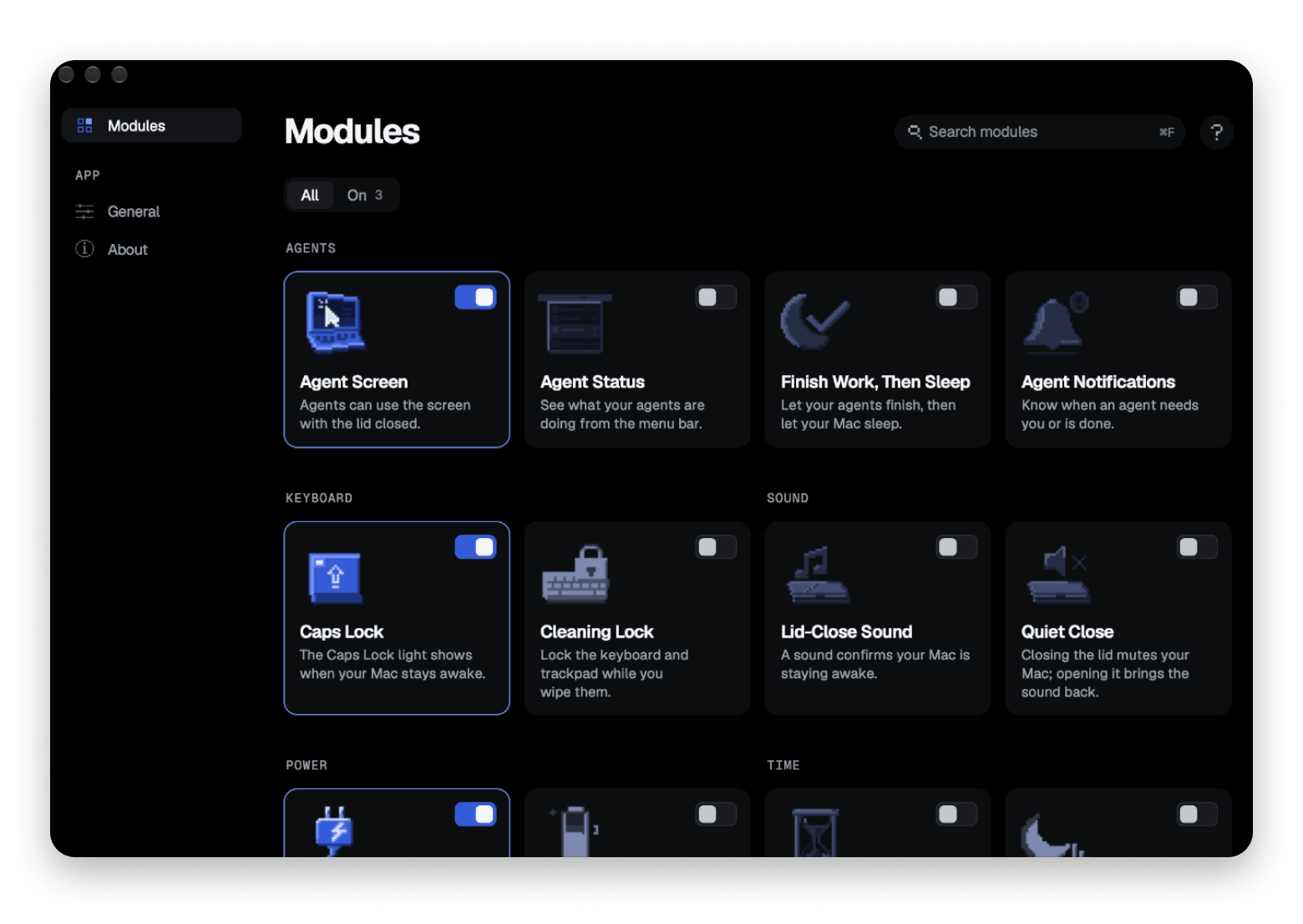
When Claude Code took off, the way people used their MacBooks changed completely. You no longer had to be in the loop for work to happen, and that's how the meme of people carrying half-open MacBooks around was born. One of those memes sparked the idea for Clamshell: what if closing the lid didn't mean your agents stopped?
I'm a 19-year-old student from Hungary. My background is in 3D animation: I'd been using Blender for over three years by the time I started Clamshell. Clamshell is my first product — before it, I'd never shipped any software. That background turned out to matter more than I expected, though: years of obsessing over how things look and feel carried straight over into how I design an app.
Building it without admin rights
I built a working MVP quickly, but it required admin rights, and asking for a password or installing a system-level helper didn't feel like a good user experience to me. So I spent a lot of time experimenting until I could keep the Mac running with the lid closed without any admin rights at all.
A gesture instead of a toggle
Once that worked, the next problem was arming. How do you make sure Clamshell is on only when you actually need it? That's where the Option-close gesture and the lid-close animation came from. You hold Option while closing the lid, and Clamshell arms right at that moment.
I think it's the most natural way to arm an app like this, because closing the lid already is the moment you decide to walk away. There's no toggle to remember to turn on and, more importantly, none to forget to turn off. If you close the lid normally, your Mac sleeps like it always has. If you hold Option, it keeps working. The intent and the action are the same gesture, and the animation confirms it before the screen goes dark, so you never have to wonder whether it worked.
I've always loved how MacBooks are packed with sensors that seem unnecessary but open the door to really creative uses. Clamshell's lid-close animation is driven by the lid angle sensor, and I remember spending whole nights perfecting it.
Getting the safety balance right
My first instinct was to leave the user in complete control. I didn't want someone's work to stop just because their battery crossed an arbitrary threshold, so at first low-battery disarm was an option you could turn on, not the default. Testing changed my mind: a hard cutoff is much better than a Mac running completely flat in a closed bag. Now Clamshell disarms at 20% by default, which matches the point where macOS shows its own low-battery warning, and you can still adjust it or turn it off.
Thermal safety is a different story: it's always on, and you can't turn it off. If the Mac gets too hot with the lid closed, Clamshell disarms and lets it sleep.
Honestly, I still don't think a hard cutoff is the ideal answer. I'm working on a way to gracefully pause AI agents when the Mac needs to stop, whatever the reason, so this new lid-closed workflow feels much smoother.
My tools, then and now
When I started Clamshell, I used a lot of tools: Claude Code in the terminal, Figma and Blender for design, Xcode for polishing the app, Cloudflare for hosting, and Final Cut for video editing. I also kept switching between Codex and Claude, depending on which lab had the best models at the time.
As the models have improved, my toolkit has shrunk. Today I mostly use T3 Code, plus Procreate on my iPad for design. AI handles much more of the work now and needs far less hand-holding than it used to, especially with design. I can send a rтough hand-drawn sketch, and it turns it into a clean, polished UI.
That said, I don't want to remove myself from the loop completely. I think taste still matters a lot, and I believe it always will. AI does its best design work when you give it good direction.
Marketing: show up where the question already is
My strategy is pretty simple: show up wherever people are already asking the question Clamshell answers. Most people find Clamshell by searching for things like "will Claude Code keep running if I close my laptop," so I wrote guides that answer those questions honestly, including when you don't need an app at all. Those guides turned out to matter twice: Google sends people to them, and AI assistants like ChatGPT and Copilot cite them when someone asks which app to use. AI assistants are now my fastest-growing source of new users.
The other thing that works is the product itself. Clamshell has a free trial, and most people who buy do it inside the app after trying it, not on the website. So my job is mostly to get people to try it. The app does the convincing.
A few other channels made a real difference. Launching on Product Hunt brought noticeable interest early on, and a Homebrew cask has brought a steady stream of developers since day one. The biggest boost so far, though, came from Setapp's own "How to stop Mac from sleeping" guide. When Clamshell was added to it, I saw one of my best sales days yet, so a big thank-you to the Setapp team for that.
What didn't work was short-form video. I made around a hundred YouTube Shorts. They got about 14,000 views but brought almost no sales, so I stopped. For a utility like this, people don't discover it while scrolling. They find it when they have the problem.
I measure everything I can, and after buying, people are asked how they heard about Clamshell, so I can drop what doesn't work quickly instead of guessing.
The mistake that taught me the most
My biggest mistake was being too strict about keeping Clamshell minimal. Every feature had to survive brutal testing before it made it into the app, and the ones that didn't were dropped. Meanwhile, I was getting a ton of feature suggestions, and it hurt not being able to add them for the people who genuinely needed them.
I've learned from that, and it's what shaped the biggest update in Clamshell's history: a complete rethink of the app, built around the features people have been asking me for since day one, without giving up the simplicity that made Clamshell what it is. If all you want is to close the lid and keep working, nothing changes for you. If you've ever wished Clamshell could do just a little more, this one's for you.
Moments I'm proud of
Two moments stand out. The first was my very first sale. It felt incredible that someone paid real money for something I'd built. The second was getting accepted into Setapp's catalog. Knowing Clamshell made it into a curated collection of just a couple hundred apps felt like a real stamp of approval.
Advice for anyone starting out
First, taste still matters. AI can build almost anything now, so your taste and the direction you give it are what make your app stand out. Second, the best things you can build are fixes for problems people are already trying to work around. If people are hacking together their own solutions, the need is real.
But honestly, if I had to start over, I'd simply start with the first idea that came to mind and keep polishing it. Getting started matters much more than figuring out the perfect thing to build.






 Best solution
 Best solution