Best calendar apps for iPhone: Comparison table (2026)
Time is irreplaceable, and many of us wish we had more of it. We can't freeze time – but we can manage it effectively with a reliable calendar app on our phones. I'll start with a quick overview and then dive into the details:
9 different views (including 4-day, agenda, year), natural language input, clean focused interface, reliable offline mode
Free version is limited, no built-in task manager or video call features
TickTick
Productivity enthusiasts wanting tasks + calendar in one app
Free (basic); Premium $3.99/mo or $35.99/yr
All-in-one (calendar, tasks, habits, Pomodoro, Eisenhower Matrix), time-blocking, cross-platform, Siri support
Can feel overwhelming for beginners, some advanced views require premium
Author disclaimer: 've personally tested and verified every app in this article based on editorial standards. You can learn more about how we choose the apps we recommend. I do my best to keep this article updated, but I still recommend doing your own research before installing or purchasing any software.
6 best calendar apps for iPhone
Let's not waste any more time and jump right into comparing calendar apps for iPhone.
1. Calendars for seamless cross-account syncing
Calendars is my best calendar app for iPhone as someone whose life can't fit in one calendar account.
As the name suggests, it's actually a calendar tool that brings all your other calendars into a single platform. It also has a built-in task manager, which means you don't have to switch between Apple Calendar, Google Calendar, Outlook, and Reminders.
One of the features I like most is that I can just type "team call with Sarah on Thursday at 2 pm at the office." The app will automatically capture the name, time, day, and location, better than any other I've used. It will even add a button to open the call, which comes in handy when you have a lot on your plate.
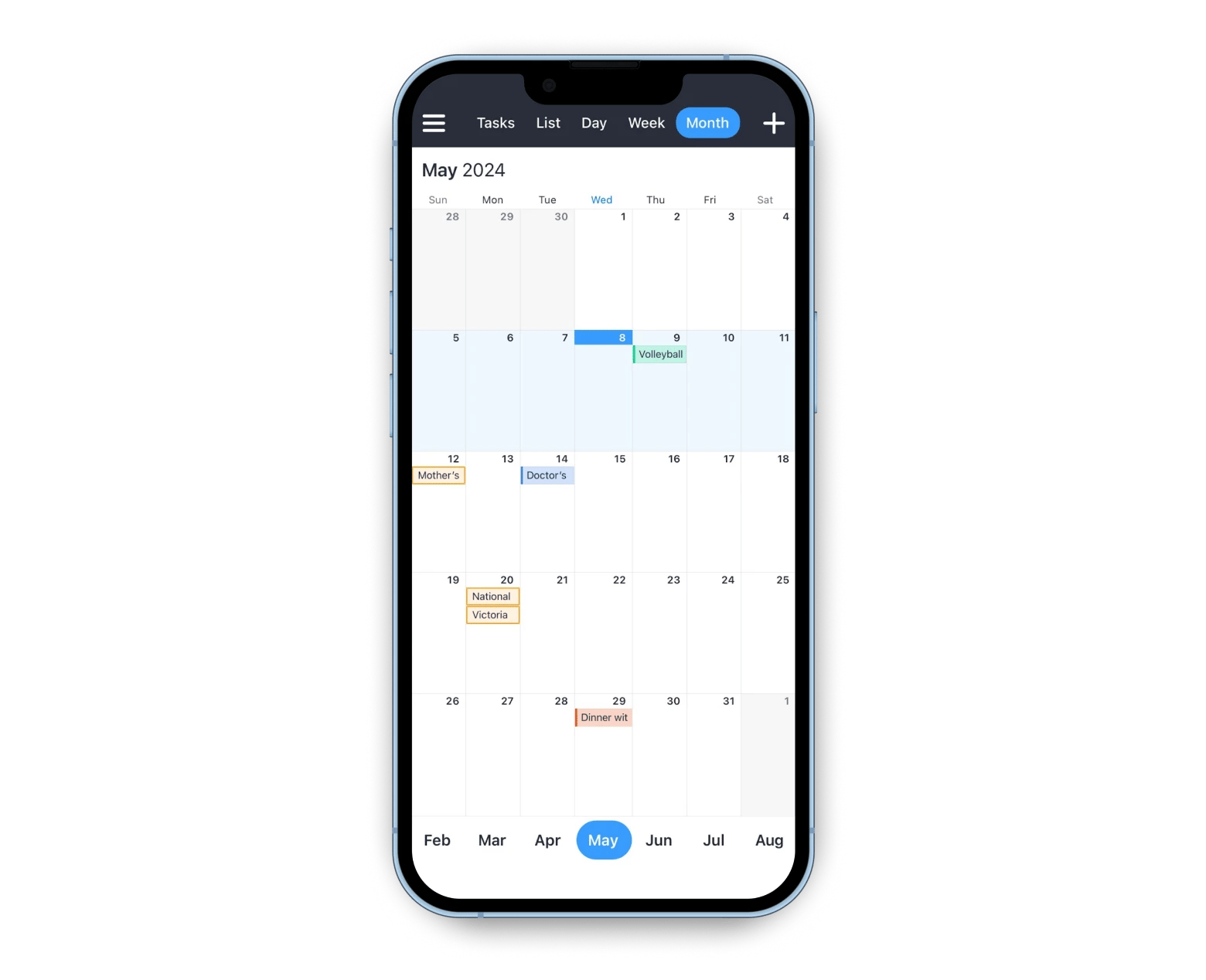
Despite combining multiple calendars, a to-do list, and reminders, the interface remains quite simple. To give you an idea of the design, one Setapp user quote describes it as "Much clearer and easier on the eye than the native app... as a visual person, I appreciate this a lot."
Calendars is best for
Mac and iOS users who want to consolidate their iCloud, Google, and Outlook calendars, especially when managing both work and personal schedules.
Problems Calendars solves
Calendar clutter: The Calendars app lets you combine your iCloud, Google Calendar, and Outlook account calendars into a single view.
Slow event creation: You don't have to click 10 confusing buttons — instead, you can create an event by typing using natural language. It will automatically pick up the contacts, locations, and times.
Disconnected planning: Your tasks and reminders sit alongside your calendar events from different accounts, making it easy to spot conflicts and gaps.
Calendars' feature benefits
Syncing with iCloud, Google Calendar, Outlook, Reminders, and Google Tasks brings everything into one dashboard.
Creating tasks with natural language makes entries easy and fast.
Individual event color-coding (beyond per-calendar coloring) helps get a quick snapshot.
Integrated task lists for to-dos alongside events make it easier to create calendar events and manage your day.
"With back-to-back meetings and shifting priorities, I need a calendar that does more than just hold events. Calendars lets me color-code my day, use natural language to add meetings in seconds, and sync everything across accounts — it's the only way I stay sane and on time", shares Oleksandra Melnyk, Product Marketing Manager.
Calendars' strengths
The interface is praised for being cleaner and more visual than native calendar apps.
Tasks and events live side by side, which creates a more realistic picture of your day.
It syncs across iPhone, iPad, Mac, and Apple Watch so you can stay updated on the go.
It automatically pulls your meeting links and integrates a video call button for quick task switches.
Calendars' limitations
There's no menu-bar interface for quickly checking upcoming events on Mac.
The subscription may not feel justified if Apple Calendar already meets your needs.
Using Calendars in your workflow
The Monday morning reset is where Calendars comes in handy. Instead of switching between your Apple Calendar, Google Calendar, and Outlook, you can see everything in one view. When you need to move any task or event, just drag it or type in natural language for a new one. And if it's time for a virtual call, tap on the link from here. The beauty of it all is that you can still rely on the automation provided by more integrated calendars like Apple Calendar and Google Calendar, then use this one as your client interface.
Pricing info on Calendars
Calendars is included in Setapp Membership alongside hundreds of other Mac, iOS, and web apps. If bought from the developers, it is $19.99/year.
2. Apple Calendar for deep ecosystem integration
Apple Calendar is part of the Apple ecosystem we all can't seem to escape, and it has some sort of magic that still brings me back despite relying heavily on Calendars.
It's free, already installed on all Apple devices, syncs across all your Apple devices via iCloud, and integrates with iOS and macOS in ways third-party apps can't replicate. Starting with Siri, which lets you add events hands-free, to others like Spotlight and Focus modes.
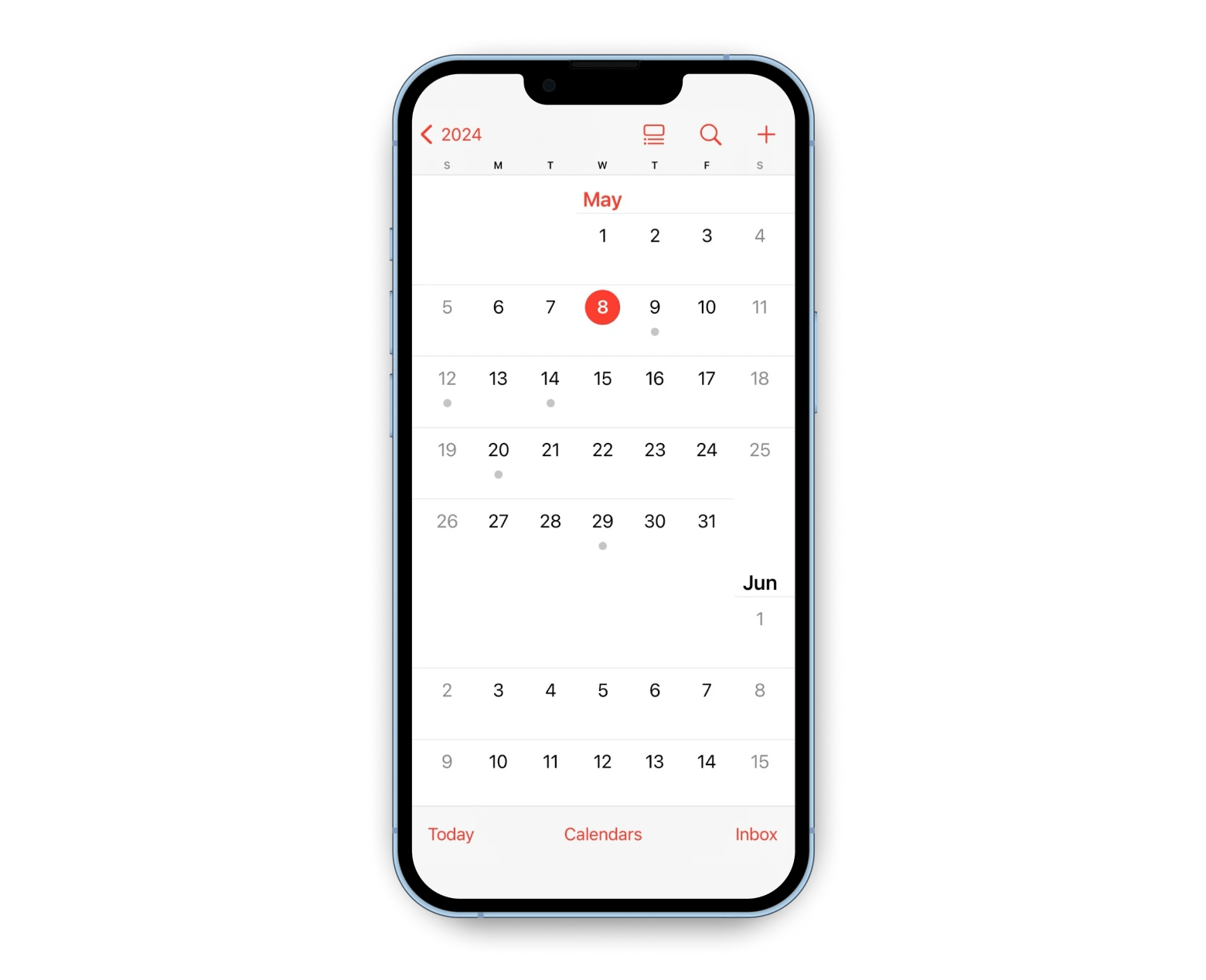
The app itself is still quite minimal, but Apple keeps updating it to make it more intuitive. For example, it offers Compact, Stacked, and Details month view options with pinch-to-zoom instead of just non-interactive dots. It also has a limited natural language event creation.
In most cases, I use it for simple events and reminders, as it still links with Calendars for an all-in-one view.
Apple Calendar is best for
People who are fully invested in the Apple ecosystem and want a simple, reliable calendar that works seamlessly across iPhone, iPad, Mac, Apple Watch, Siri, Reminders, and Maps.
Problems Apple Calendar solves
App clutter: It's already working on your Apple device, so there's nothing you need to download or set up.
Manual event entry: You can use Siri to create, update, and manage your events and reminders with voice commands.
Disconnected reminders: It integrates directly with Apple Reminders, so tasks and events are available on the same app.
Apple Calendar feature benefits
Instant iCloud syncs across iPhone, iPad, Mac, and Apple Watch make it easy to stay updated on the go.
Apple Maps integration automatically sends you "time to leave" notifications based on live traffic.
Automatically pulling event suggestions from Mail and Messages saves time used on manual entries.
Flexible Month view layouts (Compact, Stacked, and Details) with pinch-to-zoom to show full text event titles on the main grid.
Apple Calendar strengths
Deeper iOS integration than any third-party app, making it one of the best calendar apps for iPhone.
It has a clean and minimal interface that loads fast and stays out of the way.
The app is completely free, with no subscription, setup, or in-app purchases.
Apple Calendar limitations
You can't customize colors for a specific event — they are tied to the overall account.
The natural language event creation isn't as powerful as in the Calendars app.
Power users quickly outgrow the app due to the limited customization and planning features.
Using Apple Calendar in your workflow
Every iPhone comes with the Apple Calendar, so no download is required. The downside is that connecting other calendars can be a tedious process compared to other apps. To do so, you'll need to:
Go into Settings on your iPhone.
Navigate to Calendar.
Tap Accounts.
Tap Add Account.
Click on one of the calendar options available, or add your own.
You'll find a selection of all major calendars, but if the app you want to connect to isn't listed, you likely won't be able to connect it to the Apple Calendar.
I find that Apple Calendars works best when you use it as a background layer instead of an active planning tool. For example, I rely on Siri to add events quickly when I'm busy or driving. But when I actually want to plan an event, I feel that the interface doesn't give me much to work with.
Pricing info on Apple Calendar
Free and pre-installed on all Apple devices.
Read also:
3. Google Calendar for Google power users
Google Calendar is another of the best calendar apps for iPhone, but most of that is due to what happens around it. If you are heavy into services like Gmail, Google Drive, and Google Meet, Google Calendar feels like a place where everything comes together.
One of its most impressive features is auto-event creation. If you book a flight, it creates the event and imports the details. The same goes for meetings. It also combines multiple Gmail accounts to give you a detailed view of upcoming events.
Google Calendar also combines with Google Tasks to let you manage everything without switching apps. And unlike Apple Calendar, you can add colors to specific events to get better overviews of your day.
However, the utility quickly goes down if Google is just a search engine in your daily tasks.
Google Calendar is best for
Heavy Gmail and Google Workspace users who want their calendar to work as part of the larger productivity ecosystem.
Problems Google Calendar solves
Manual event logging: It automatically pulls calendar entries from Gmail confirmations, including things like meetings, flights, hotels, and other reservations.
Scattered meeting assets: Instead of sharing files via Slack or other methods, you can just attach Google Drive files with a few clicks.
Team scheduling friction: You can add a Google Meet link to any event with a single tap.
Cross-platform inconsistency: It offers the same experience across iOS, Android, and web, meaning you can use it on any device.
Google Calendar feature benefits
Deep integration with Gmail, Google Drive, and Meet helps automate tasks like creating events and sharing meeting links.
Individual event color-coding makes busy calendars easier to scan and organize.
Shared calendars make it easy to coordinate with colleagues and team members.
Google Calendar strengths
Automatic event creation saves travelers a lot of time.
Creates Google Meet links with a single tap to avoid repetitive processes.
You get much more flexible color-coding and customization options compared to Apple Calendar.
Consistent experience across iOS, Android, and web.
Google Calendar limitations
The interface can feel visually busy compared with the clean interface of Apple Calendar.
Its strongest features rely on the use of Gmail and other Google services.
Using Google Calendar in your workflow
Google Calendar is quite useful if your personal and/or work communications happen on Gmail. When you receive a meeting invitation, the calendar will import it automatically and give you a Google Meet link. If you receive a flight or hotel confirmation, it will add the necessary details to your calendar. Now, add that to the ability to create an automatic Google Meet link, directly add Google Drive files, and see your colleague's availability when creating meetings. You'll have a calendar that does most of the administrative work for you.
Pricing info on Google Calendar
Free.
4. Microsoft Outlook Calendar for professional scheduling
Microsoft Outlook Calendar is oriented towards people who are always juggling meetings in a corporate environment. It's part of the Microsoft Outlook app and designed to make scheduling as easy as possible.
You can flip between your email thread and your calendar with a single click. You can also convert an email into a meeting with just 2 clicks and even check your schedule while drafting.
Even more impressive is the Scheduling Assistant, which I feel sets Outlook apart from most of the other apps on this list. When you set up a meeting in Microsoft 365, it shows everyone's availability side by side before you send the invite. No more "does Tuesday work for everyone?" email chains.
But then, as you can expect, even most of the other features are geared towards corporate environments. If you are a freelancer or your profession isn't heavy into meetings, it may not be the best fit. The interface is also not the best on iOS, given that it's an email and calendar app in one.
Microsoft Outlook is best for
Professionals and enterprise users who use Microsoft 365 and want email and scheduling in one place. It also works for people who regularly arrange meetings with multiple attendees.
Problems Microsoft Outlook solves
Email and calendar disconnect: Email and calendar live one click away from each other, and you can create meetings directly from emails.
Scheduling conflicts: The scheduling assistant shows each attendee's availability in real time, making it easy to choose a time slot that works for everyone.
Fragmented work tools: It connects with Microsoft Teams and To Do to ensure that meetings, notes, and tasks live in one place.
Microsoft Outlook feature benefits
The combined nature of the app brings together email, calendar, contacts, files, and search within a single app.
Scheduling Assistant helps find shared availability with multiple attendees without back-and-forth emails.
It syncs with multiple other MS 365 apps to simplify task and event planning.
Microsoft Outlook strengths
The email and calendar integration is one of the best available.
It fits natively when using Microsoft Exchange or 365.
It's one of the best calendar apps for iPhone if you are always coordinating meetings between large teams.
Email, calendar, Teams, and To Do integration reduces the need for multiple separate apps.
Microsoft Outlook limitations
The combined Mail and Calendar interface requires adjustment on the iPhone's small screen.
Syncing with the native iOS Calendar is sometimes unreliable.
Using Microsoft Outlook in your workflow
The app's workflow is justified in meeting-heavy setups. When an email arrives requesting a call, you can setup a meeting with two clicks. Since you can see your colleagues' or team's existing commitments, you can just pick the next available slot and send. The Teams link is already in the invite.
Pricing info on Microsoft Outlook
Free for personal accounts (Outlook.com or Gmail), but you need Microsoft 365 for advanced business features.
5. Tiny Calendar for a multitude of views
Tiny Calendar is the best calendar app for iPhone if you feel your life doesn't fit into a single calendar perspective. Instead of just a daily and monthly view, Tiny Calendar offers 9 standard views: Forecast, day, week, month, 4-day, year, mini-month, week agenda, and agenda.
This defines how useful the app is. For example, I find the 4-day view quite useful in seeing what's coming up, without losing sight of the immediate tasks and events ahead of me.
Besides that, the app doesn't try to be a do-it-all. It simply syncs with your iOS, Gmail, and Outlook calendars to ensure you are up to date. It also simplifies event creation by allowing natural-language entries.
The other thing worth noting is that the interface is quite aesthetically pleasing and easy to use.
Tiny Calendar is best for
Users who want to consolidate different calendars with more flexibility in how they view and organize their schedule.
Problems Tiny Calendar solves
Rigid calendar layouts: With 9 viewing options, the app gives you more ways to visualize your schedule.
Offline access issues: You can create, edit, and delete events without the internet. The changes sync automatically when you are online.
Complicated interfaces: Tiny Calendar offers a simple, clean, and intuitive interface that's focused purely on calendar management.
Tiny Calendar feature benefits
9 customizable to give you flexibility on how you view upcoming and future tasks.
Syncing with your Google accounts and the local iPhone calendar is fast and reliable.
Drag-and-drop functionality makes it easy to adjust your time blocks.
Tiny Calendar strengths
Syncs instantly with the local iOS calendars.
Works without an active internet connection.
Has a clean and focused interface.
Tiny Calendar limitations
The free version is quite limited.
There's no task management or video call integration.
Using Tiny Calendar in your workflow
Tiny Calendar only needs one permission during setup to sync with all your local calendar databases. From there, the 4-day view is the one that can change how you use your calendar app from day to day. It provides enough context to spot a Wednesday trip that collides with a Thursday deadline, without the overwhelming feeling of a monthly or weekly view. When you pair that with offline use, the calendar starts feeling more trustworthy than just functional.
Pricing info on Tiny Calendar
Free for basic use, with a $2.99 per month subscription or a $22.99 one-time payment
6.TickTick for all-in-one productivity
TickTick is the best calendar app for iPhone when you want much more than just a simple calendar. It's an all-in-one productivity planner that has a calendar, a complete task manager, a habit tracker, an Eisenhower Matrix, a countdown, and even a Pomodoro timer.
This makes it a go-to when you have a lot going on. You can use it for pretty much everything, from organizing work and collaborating with colleagues to planning your shopping list. You can also upload attachments to tasks, set priority levels, and use Siri to create tasks faster.
However, as a full productivity suite, the interface isn't the most straightforward for beginners looking to upgrade their calendar.
TickTick is best for
Productivity enthusiasts, students, professionals, and people with ADHD who want to manage tasks, habits, focus sessions, and calendar planning within a single system.
Problems TickTick solves
Task and calendar separation: It lets you quickly switch between the two, and you can even convert tasks into calendar events.
Lack of focus: It has a Pomodoro timer with a White Noise engine and focus statistics to help keep your head down when you want to avoid distractions.
Poor prioritization: The Eisenhower Matrix can help you organize tasks based on urgency and importance.
Tool overload: You don't need to download 5 different tools, as TickTick is an all-in-one productivity suite.
TickTick feature benefits
It offers a task manager, calendar timeline, habit tracker, and a Pomodoro timer in one interface to give you a complete personal planner and productivity toolkit.
Siri task entrance allows users to add reminders and events hands-free.
It has several customizable widgets that are well-praised for their information density.
TickTick strengths
Combining 6 productivity tools makes it more practical than using a typical calendar.
Time-blocking is quite easy thanks to drag-and-drop scheduling.
You can convert tasks into calendar events with a few clicks.
Cross-platform support is as good as any – iOS, Mac, Windows, Android, browsers, and web.
TickTick limitations
Siri integration isn't as reliable as in native Apple apps.
The interface can feel overwhelming for new users.
Multi-calendar views are only available on the premium plan.
Using TickTick in your workflow
TickTick works best for people who deal with project-heavy weeks. You can open the app on Sunday, convert your tasks into time slots on the calendar, and flag the non-urgent ones in the Eisenhower Matrix. On Monday, you then have a Pomodoro timer you can use to work in short, focused bursts.
And if you are trying to reduce your social media use, there's a habit tracker. This is a different relationship with your calendar than most apps can offer.
Pricing info on TickTick
Free plan (basic features), with premium subscription at $3.99 per month or $35.99 per year
Choosing the best Calendar app for your iPhone
When you're on the hunt for the best iOS calendar app for your needs, the features and interface that come with these apps are sure to make a difference. Regardless of its extra nice-to-haves, the app should have a clean and easy-to-use user interface that is compatible with, at least, the Apple Calendar (unless you're looking to start from scratch). Flexible viewing options will let you view your schedule the way you prefer, while customization and multiple calendar options can help elevate your time management tenfold.
Some of the apps mentioned, including Calendars, are available through Setapp, a subscription-based service that gives you access to 250+ native Apple iOS apps.
Whether you're looking to improve your scheduling, boost productivity, keep your Mac performing optimally, or organize your files and folders, Setapp has an app or two to fulfill those needs. Start your 7-day trial and check out just what Setapp has to offer.
Superpowers for your iPhone
Power up your workflow with apps for Mac and iOS on Setapp.






 Top-rated on Setapp
 Top-rated on Setapp