macOS has no built-in Volume Mixer, but there are alternatives. • eqMac — Closest WVM experience, partially free, per-app volume sliders and equalizer levels: • Boom3D — Adds 3D surround sound, EQ presets, and app-specific volume. • Silenz — Adjusts your music to the environment automatically. • Audio Hijack — Captures, routes, and applies real-time effects to any audio source on your Mac. Pair it with JoyCast to clean up microphone noise on calls and recordings. •BackgroundMusic —Adds per-app volume sliders, lives in the menu bar, free.
Boom3D and Silenz are both in Setapp — try them FREE. Start your 7-day Setapp trial — Cancel before day 7 — $0 charged.
Even though I'm a Mac user, I know that Windows is renowned for its selection of useful features, which sometimes surpasses macOS in terms of technicality and customization. While I appreciate Apple keeping things simple and super user-friendly, it can sometimes be frustrating if you need more advanced features.
If you use your Mac for musical projects, the lack of control over your volume and sound can be frustrating. Especially if you've used Windows devices before, you might be searching far and wide for a Volume Mixer for macOS. As it can control the audio levels of individual applications, it can completely change your Mac experience.
Is there a Volume Mixer on Mac (built in)?
Unfortunately, macOS (including Tahoe 26) has no built-in Volume Mixer for per-app control. After all, Apple is hyper-focused on a minimalist design, so a lack of advanced tools helps uncomplicate the user experience and keeps the front and back end separate.
Luckily, there are plenty of alternatives you can choose from:
Not sure which audio app actually fits your workflow? This Mac productivity tools assistant is good for working through the decision without reading every comparison table out there. I've used it when I couldn't decide between two similar-sounding tools and wanted a practical tiebreaker.
Best Volume Mixer alternatives for Mac (free & paid)
I'll be going over a few Volume Mixer equivalents for Mac that come with a variety of unique features to serve different needs.
Boom3D — Best for boosting audio + EQ (and per-app control)
Best for: Users who want to enhance audio quality
Platforms: Mac
Pricing: Available through a Setapp Membership — one subscription, 250+ Mac apps
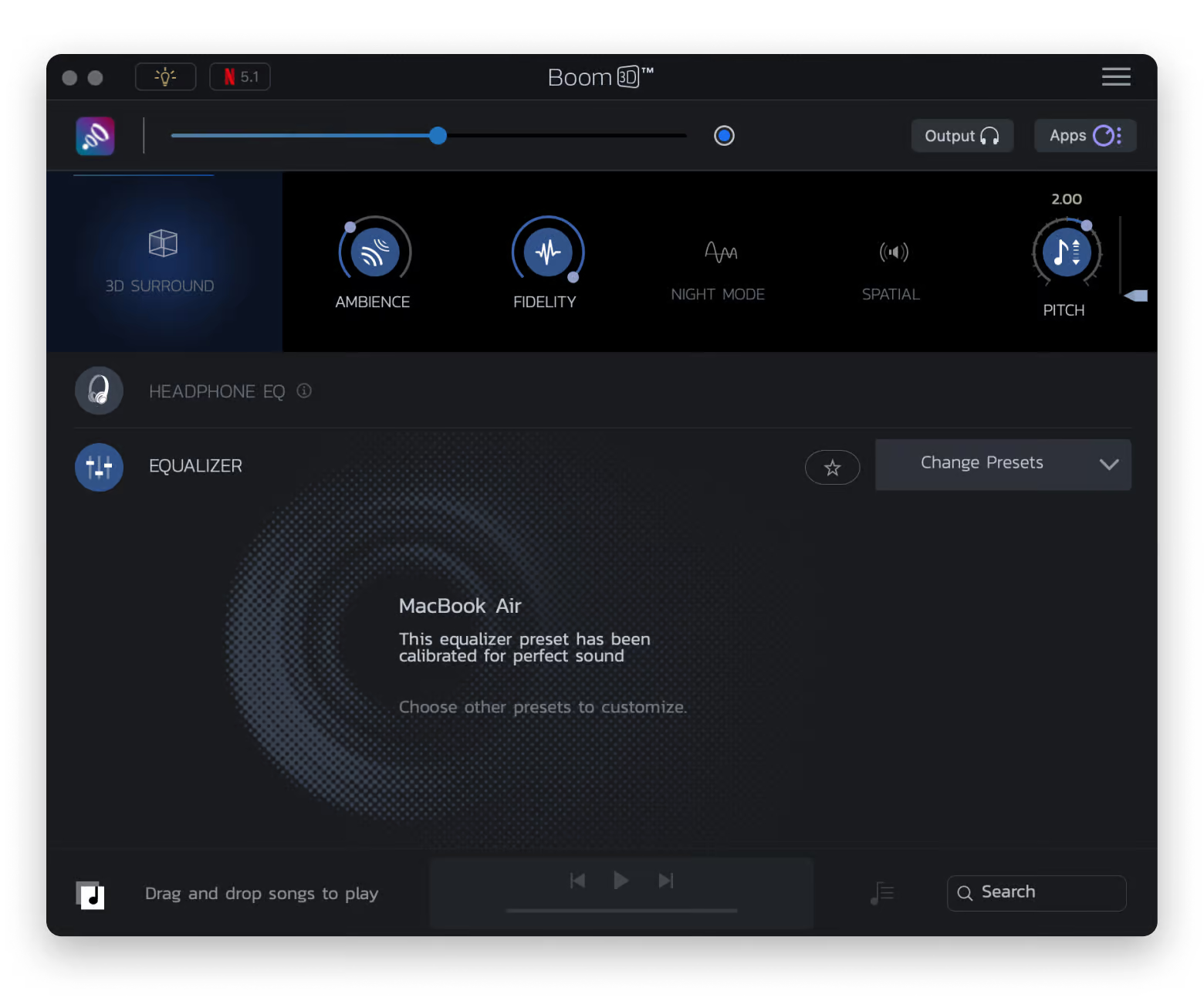
Boom3D gets deep into your Mac's audio hardware, which is of brilliant quality, by the way, and lets you actually harness its full potential. It's essentially a sound enhancer that lets you access sound-boosting presets, use sliders to customize your own sound, and enjoy patent-pending 3D Surround Sound through your earphones or speakers. For example, I use it to both reduce notification sounds from other apps while listening to music on Spotify and customize my listening experience through higher ambiance and fidelity. There are also other features, like a Netflix surround sound extension.
Pros:
Immersive audio experience with manual and automatic audio setup options
Customizable equalizer
App-specific volume control
Cons:
Can be resource-intensive
May have a learning curve for less experienced users
Pricing: Available on Setapp, a platform with 250+ apps for Mac, iPhone, and iPad. Install as many apps as you want. Pay a flat fee once a month for all. Find out if Setapp is cost-effective for you with this free, quick Cost-saving calculator. It will analyze your current setup and estimate how much you could save on apps.
Silenz — Best for focus mode (adaptive sound while you work)
Best for: Users who want to focus while playing music
Platforms: Mac
Pricing: Available through a Setapp Membership — one subscription, 250+ Mac apps
Silenz practically has the opposite functions of Boom3D, as hinted at in the name. While Boom3D seeks to increase the sound experience, Silenz is all about getting rid of distractions to keep you focused. If you're in a bout of deep work, the app can pick up sounds from your environment and either combine your music with it or silence it so you can hear people talking. Rather than having to press pause every time, your music can become a natural part of your workflow.
Pros:
Adaptive sound control
Ideal for concentration and deep work
Simple menu bar interface
Cons:
May have to adjust sensitivity settings a lot before getting it right
Not a versatile tool with only one main purpose
Pricing: Available on Setapp, a platform with 250+ apps for Mac, iPhone, and iPad. Install as many apps as you want. Pay a flat fee once a month for all.
Music that adapts to your environment automatically — so you never have to hit pause. Silenz picks up ambient sound and adjusts your volume in real time — ideal for deep work sessions. Try Silenz Free.
eqMac — Best free Volume Mixer-style per-app volume control
Best for: An equalizer with per-app volume adjustment
Platforms: Mac
Pricing: Free, paid plan from $3/mo
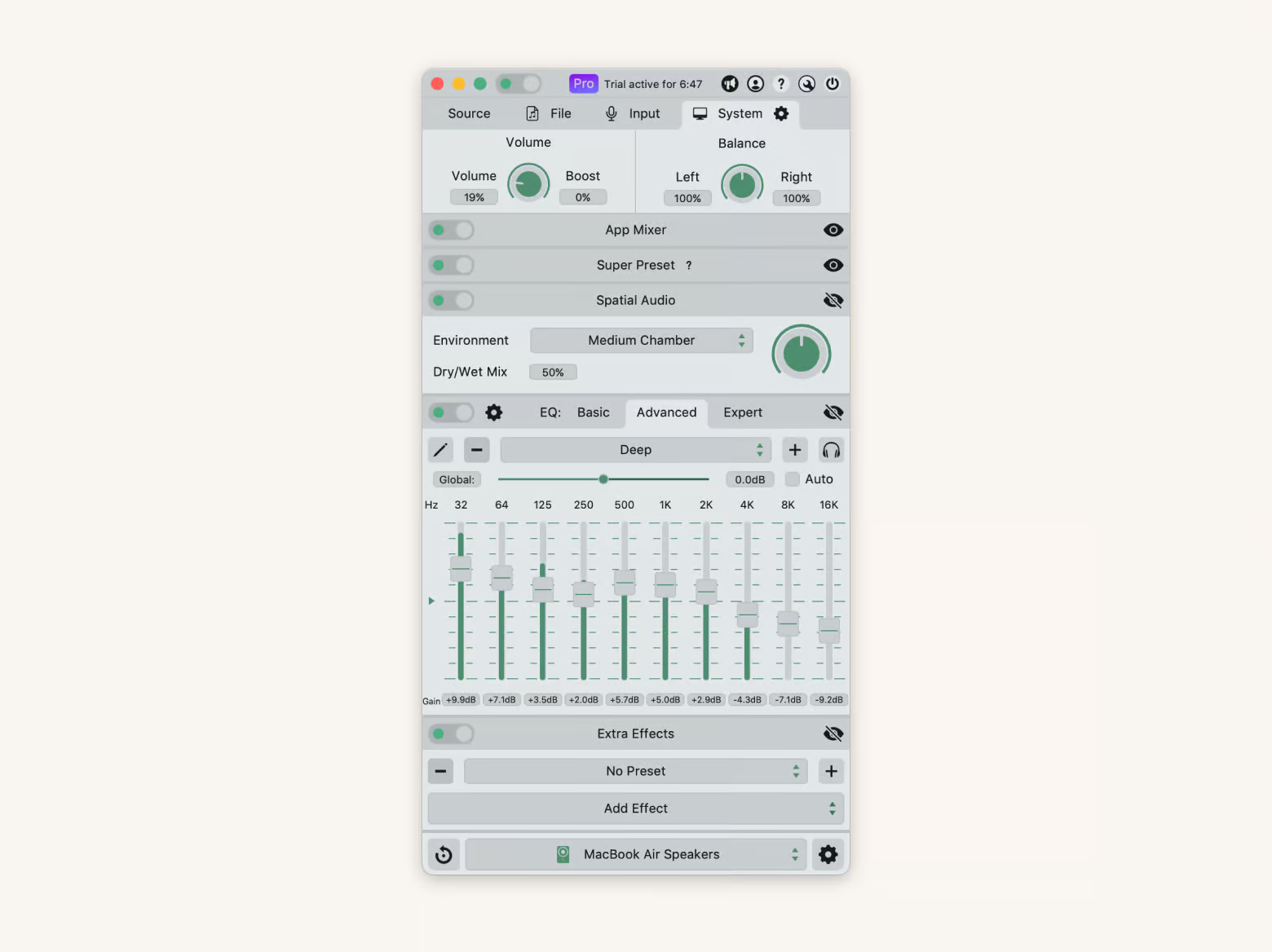
eqMac is a free system audio processor for macOS that accommodates a wide range of users with different skill levels. It features a basic equalizer, an advanced equalizer, and an expert equalizer, so you can select one depending on how experienced and comfortable you are with those tools. There's also a Volume Mixer for macOS, just like on Windows, where you can adjust volume per application on your system, presets for 4,600+ headphones, spatial audio, and plenty more audio-related tools. What's cool about eqMac is that it also lets you fully customize the look and feel of the app and control it with keyboard shortcuts.
Pros:
Custom equalizer settings for all skill levels
App-specific volume controls
Varied features in one simple interface
Cons:
Lack of features under a free plan
Reports of crashes
Pricing: Free option available, with the paid plan from $3/month.
Audio Hijack — Best for recording/routing system audio (podcasts & streaming)
Best for: Creators who need to capture and route audio from different sources
Platforms: Mac
Pricing: $69.00 one-time
I have to say, these apps have great, fitting names. Audio Hijack is one of those examples, allowing you to record audio from a website or app. Maybe you want to capture a meeting on Zoom or save podcast audio, or perhaps you need to reroute sounds for your live stream. With an all-in-one interface, you can essentially control an entire audio workflow with easy drag-and-drop functions. If you're serious about sound recording and customization or work as a streamer or podcaster, it's a must-have tool despite the potential learning curve.
Pros:
Lets you record from any input source
Can apply real-time effects while recording
Versatile use cases
Cons:
May be too complicated for the average user
Focused on recording rather than audio adjustments
Pricing: From $69.00
Image source: rogueamoeba.com/audiohijack
Background Music — Best free menu bar per-app volume control (Lightweight)
Best for: Simple per-app volume sliders
Platforms: Mac
Pricing: Free (open-source)
MacUpdate's Background Music is a simple audio utility that lets you record system audio, set per-app volume levels, and automatically pause your music. It does multiple things in a simplistic, stripped-down manner that you can control through your menu bar.
Pros:
Basic functions for those who are only looking for per-app volume control
Minimalist interface
Auto-pause feature
Cons:
Very limited in functionality
Limited audio channel support
Some users report compatibility issues on macOS Tahoe 26
Pricing: Free
Best free Volume Mixer for Mac (top picks)
If you don't want to spend anything, you still have some solid options.
Background Music is the best free Volume Mixer for Mac as it gives you the per-app volume sliders found on Windows. It's completely free and open source, and it stays out of your way by hanging from the menu bar.
eqMac is the other free alternative, but its free features are mostly focused on equalizing volume. If you want to control volume based on the source, you need to upgrade.
If you already have Setapp, you can install Boom3D and Silenz at no extra cost.
How to control volume per app on Mac (step-by-step)
macOS doesn't have a native way to control volume per app, but we've looked at several apps that do. Here's how to do it using Background Music.
Download and install the app from MacUpdate.
Launch Background Music.
Click on the app icon from the menu bar.
Drag any slider up or down to adjust volume.
The process is similar for other apps, except for the menu bar, since the others are full apps.
Permissions and audio drivers to expect (macOS security prompts)
After installing any of the Volume Mixer alternatives listed, they'll typically request a few permissions:
Automation
Microphone
Accessibility
These are typical for this category of apps, but be cautious of apps that ask for extensive or unnecessary permissions.
Common use cases (choose the right app fast)
In most cases, the "best alternative" just means the tool that works better in your use case. Let's look at some common ones.
For Zoom/Meet calls (taming loud apps)
If you don't want to get notification sounds when you are in a meeting, use Background Music, eqMac, or SoundSource to control the volume of various apps. You can then use JoyCast to improve your audio quality and filter out background noise that can distract your audience.
JoyCast enhances your input in real time, available in Setapp. Try JoyCast Free.
For streaming/podcasting (recording + routing)
Audio Hijack is the clear choice when you want to capture audio from different inputs. It even allows you to add real-time effects and route different audio streams to different outputs. This comes in handy when streaming or podcasting.
For music listening (EQ + sound enhancement)
Boom3D is the best alternative when you want to enhance the output quality from your Mac speakers or headphones. It offers lots of awesome equalizer presets and significantly improves audio quality.
How to choose the best Volume Mixer alternative for Mac
I covered a bunch of alternatives that all have different features. So, now that you know there are plenty of Mac equivalents out there, how do you make a decision?
Step 1: What are your needs? Are you looking to boost your listening experience on Spotify or Apple Music, or are you more interested in having granular control over specific apps? Do you have a budget for your tool, or are you insistent on a free one? Do you consider yourself tech-savvy or not so much? The more you know about what you need, the better.
Step 2: Do you want the tool to be Mac-only, or do you need compatibility with other devices? Make sure the app you choose meets those requirements.
Step 3: Opt for a free trial or demo before committing to the full app.
If you're troubleshooting a meeting setup while sorting out your audio, Hand Mirror is a handy companion — it gives you a quick camera preview from the menu bar so you can confirm your video and audio are both ready before joining a call.
Troubleshooting: when per-app volume control doesn't work
Sometimes, things may not go your way. Here are some common causes and solutions.
Some apps use exclusive audio paths — Some apps can bypass the mixer and go directly to the audio hardware. It tends to happen when using other audio and video tools.
Bluetooth device quirks — Various Bluetooth audio devices may have their own volume controls, which can cause confusion when using a volume mixer.
App updates breaking audio — Updates sometimes reset permissions, so you may need to recheck this.
Multiple audio formats — If you have multiple output devices configured, the app may not control the right one. Check the one you are using from System Settings > Sound.
In most cases, it's usually a conflict between two apps that have access to your input or output.
Volume Mixer vs audio mixer: What's the difference?
A volume mixer lets you control the volume level of individual apps. For example, you can use it to reduce your Spotify volume and increase browser volume when you want to watch a short clip. It's also the name of the Windows tool that does that — Volume Mixer.
An audio mixer is quite different, as the concept is about combining and processing multiple audio sources. It mostly applies to music production, live sound, or podcasting.
What is a Volume Mixer (And what "per-app volume" means on Mac)?
On the Mac, there's only one way to control your audio — increasing or decreasing it for your overall system. For most people, this is a good enough feature to accommodate basic tasks like listening to music and watching videos. Others (like myself) might need to manage multiple audio sources, especially if there isn't a native way to lower the volume on certain apps otherwise. Volume Mixer can switch volume for individual apps and mute apps, and it even allows for custom audio settings with features like an equalizer, making it a must-have for professionals, students, or even gamers.
How to get a Volume Mixer on Mac (download + setup tips)
Macs have an impressive Dolby Atmos immersive audio quality, so why waste it? The Volume Mixer alternatives I've covered can help you take advantage of granular controls and other tools to make your listening experience that much superior. Whether you're looking to enhance the music with an equalizer-based tool like Boom3D or bring more focus into your day with a tool that considers the sounds in your environment, like Silenz, there's a tool out there for any need.
Boom3D, Silenz, and JoyCast are all in Setapp — one subscription covers your whole audio setup. Per-app volume, adaptive focus sound, and cleaner call audio — plus 250+ other Mac apps. Free for 7 days. Get 250+ Mac Apps Free.
FAQ: Volume Mixer for Mac (per-app volume & audio mixing)
What is the best free audio mixer for Mac?
If you mean mixing or editing tracks, Audacity is a popular free option. If you mean per-app volume control like Windows Volume Mixer, Background Music, and eqMac are closer matches.
Is there a volume mixer for Mac?
macOS doesn't have a built-in Windows-style Volume Mixer, but third-party apps like eqMac, SoundSource, or Background Music can add per-app volume controls.
Does macOS have a built-in way to change volume per app?
Not natively — macOS uses mostly system-wide output volume, so per-app volume typically requires third-party utilities.
What's the best lightweight menu bar volume mixer for Mac?
Background Music is the best lightweight menu bar volume mixer for Mac. It sits on the menu bar and allows users to adjust volume on a per-app basis. It's also free and open-source.
Can I route different apps to different speakers on Mac?
Yes, you can route different apps to different speakers on a Mac with a tool like SoundSource. It allows per-app output selection, so you can direct notifications to your internal speakers while music plays on a Bluetooth speaker or headphones.
Does macOS have a Volume Mixer?
macOS doesn't have its own Volume Mixer-style app, but there are third-party tools like Boom3D and Silenz that can provide granular control over your Mac's audio.
Is there a volume manager on Mac?
There's no native volume manager on Mac. It only allows you to manage the overall system volume. However, apps like Boom3D let you do much more, such as apply sound effects or switch between audio inputs and outputs.
Why do some apps ignore per-app volume controls?
Some apps use exclusive audio paths, custom audio engines, or device-specific output, which can limit what system-level utilities can control.
Control sound with Boom 3D
Get a one-stop sound booster and equalizer for Mac.






 Top-rated on Setapp
 Top-rated on Setapp